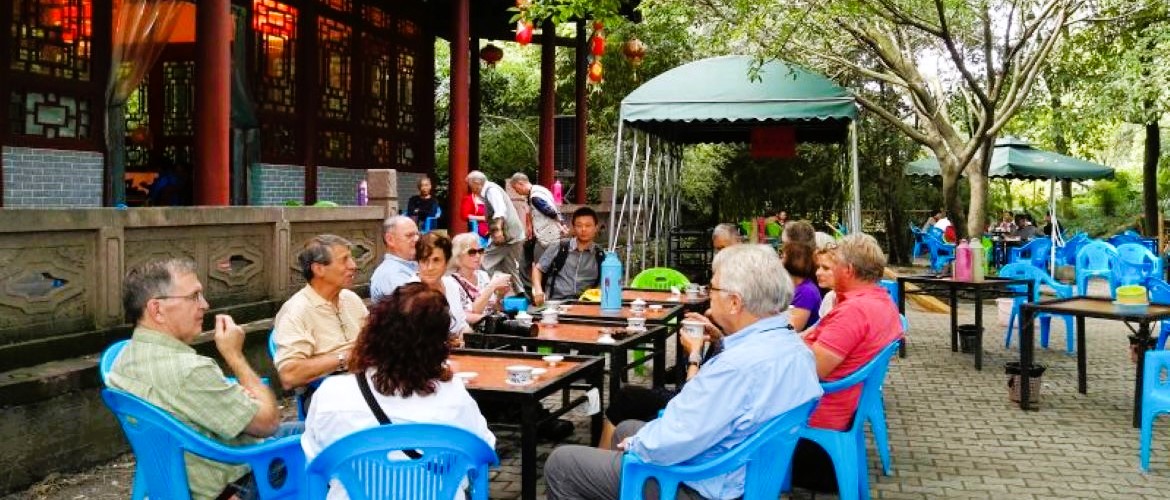
Beijing – Datong – Taiyuan – Pingyao – Zhengzhou – Luoyang – Xi’an – Chengdu – Shanghai
Step beyond the familiar into the deep soul of the Middle Kingdom. This curated journey is an invitation to witness the evolution of an empire—from grand imperial monuments to the enigmatic shadows of lost civilizations.
We move past the surface to reveal the artistry of the dynasties and the silent power of ancient masterworks hidden in stone and bronze. Every stop is a masterclass in heritage, where the past is constantly being reimagined. This is not just a journey; it is a profound immersion into a land where every mystery tells a story.
Important Features
- Small group size – average 15, maximum 20.
- Outstanding professional guides handpicked by company owners.
- Inter-city travel by high-speed train.
- No annoying forced shopping of any kind.
- Quality meals at non-tourist restaurants.
- Unlimited supply of bottled water during group activities.
- Free Wi-Fi in all hotels.
- Great Wall visit at Mutianyu with cable car rides.
- Half-day trip to Sanxingdui Museum from Chengdu.
- and so much more…
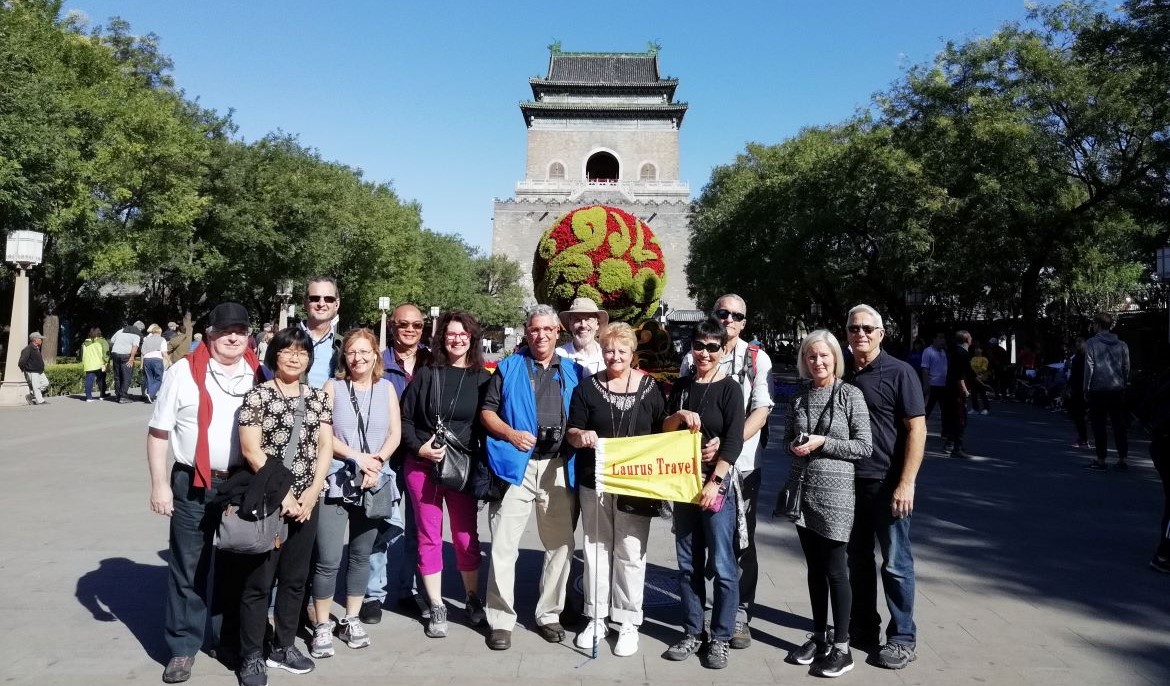
Meal Code: B = breakfast / L = lunch / D = dinner
Timeless China Unveiled (19 days)
Day 1/Thu: Departing for Beijing
The trip starts with your transpacific flight departing from a city of your choice. You’ll lose a day upon crossing the International Date Line.
Day 2/Fri: Arrival in Beijing
Meet the driver on arrival for transfer to the hotel. You’ll have the remainder of the day at leisure. The guide will get in touch with you tonight.
Day 3/Sat: Beijing (B/L/D)
We begin our sightseeing today at the Forbidden City. Officially known as the Palace Museum, the Forbidden City was the place where the emperors of the Ming (1368-1644) and Qing (1644-1912) dynasties lived and carried out their administration. The complex consists of 980 buildings and covers 72 hectares or 180 acres. It exemplifies traditional Chinese palatial architecture and has influenced cultural and architectural developments in East Asia and elsewhere.
Tian’anmen Square comes next. Located in the heart of Beijing, the square measures 880 metres from north to south and 500 meters from east to west. Said to be the largest public plaza in the world, Tian’anmen Square has the capacity to hold one million people. The imposing Tian’anmen Tower sits at the north end of the square while the Monument to the People’s Heroes dominates the centre. The square is flanked by The Great Hall of the People (west) and the National Museum (east). Chairman Mao’s Mausoleum and Qianmen (Front Gate) are located in the south of the square.
Afternoon sightseeing takes place at the Temple of Heaven. Situated in southeastern Beijing, the Temple of Heaven is China’s largest extant sacrificial temple where, during the Ming and Qing Dynasties, the emperors conducted the elaborate and most exalted sacrifices addressed to “the Supreme Ruler of the Universe.” Occupying 2.73 square kilometres (roughly 1,700 by 1,600 metres), the area of the Temple of Heaven is more than twice that of the Forbidden City.
The famous Hongqiao Pearl Market, the largest pearl market in the world, is right across the street from the Temple of Heaven. Recommended by numerous guidebooks for freshwater pearls, Hongqiao teems with domestic and international shoppers. If you are interested, please ask the guide to drop you off there. However, you’ll need to get back to the hotel by taxi, which costs less than 10 US dollars.
Tonight, we savour a delicious Peking Roast Duck dinner.
Day 4/Sun: Beijing (B/L)
After an early breakfast we embark on a full-day excursion to the legendary Great Wall at Mutianyu, 75 km northeast of the city.
Zigzagging over 6,000 kilometres from east to west along the undulating mountains, the Great Wall was built to hold off tribal invaders from the north. As history shows, the Wall failed the Chinese rulers miserably, especially in the case of Kublai Khan whose men swept across China from the Mongolian steppe, thus the beginning of the Yuan Dynasty (1279-1368).
Construction of the earliest sections of the Wall started in the 7th century BCE. A major renovation started with the founding of the Ming Dynasty in 1368 and took 200 years to complete. The wall we see today in Beijing is almost exactly the result of this effort.
Day 5/Mon: Beijing – Datong (B/L/D)
Begin your day with a visit to one of Beijing’s historic hutong neighborhoods characterized by traditional courtyard houses. Hutong refers to an ancient alleyway with siheyuan or ”4-sided courtyard house” on both sides.
Next, we explore the Summer Palace, a UNESCO site built as an imperial retreat.
The afternoon journey to Datong by high-speed train takes less than 2 hours.
Day 6/Tue: Datong (B/L)
A historic treasure in northern China’s Shanxi Province with a history spanning over 2,300 years, Datong once served as capital of the Northern Wei Dynasty (386–534). Datong is best known for the UNESCO-listed Yungang Grottoes, featuring thousands of exquisite Buddhist carvings created in the 5th century. Visitors can also marvel at the dramatic Hanging Temple and stroll along the well-preserved ancient city walls.
Our sightseeing today takes in Yungang Grottoes, Datong Museum and Huayan Temple.
Day 7/Wed: Datong – Taiyuan (B/L/D)
After breakfast, we drive 70 km to visit the Hanging Temple.
A remarkable architectural feat, the Hanging Temple is perched precariously on the cliffs of Mt. Hengshan. Built over 1,500 years ago during the Northern Wei Dynasty, this stunning temple is renowned for its unique design—clinging to the side of the mountain by wooden beams, without a foundation, giving it the appearance of “hanging” in mid-air. The temple combines elements of Buddhism, Taoism, and Confucianism, reflecting the harmonious coexistence of these philosophies.
Mt. Hengshan stands as one of China’s Five Great Mountains, known for its spiritual significance and natural beauty. The mountain features rugged peaks, scenic landscapes, and ancient temples, offering both a peaceful retreat and a stunning backdrop to the Hanging Temple. Together, these two wonders provide a breathtaking fusion of nature, history, and culture—making them must-visit landmarks near Datong.
We then drive back to Datong to board the high-speed train (2 hours) for Taiyuan.
Day 8/Thu: Taiyuan (B/L)
Taiyuan, the capital of Shanxi Province, is a historic city with over 2,500 years of continuous settlement. Long a strategic center in northern China, it has served as a military stronghold, trade hub, and political heart of the region. Today, it anchors Shanxi’s governance, industry, and cultural identity and development.
Our sightseeing begins at Jinci Temple, a historic temple complex dating back over 1,400 years. Its Song-dynasty architecture and ancient cypress trees reflect the deep cultural and spiritual traditions of Shanxi.
Shanxi Museum comes next. Shanxi Museum stands out for its diverse collection that offers a window into China’s ancient history, art, and cultural development. It is a great place to dive deep into the region’s rich heritage.
After lunch, we spend the rest of the day exploring Tianlongshan Grottoes, known for exquisite Buddhist carvings from the Eastern Wei and Northern Qi periods.
Don’t forget to go out for a stroll after dark to experience the rhythm of this dynamic historic city.
Day 9/Fri: Taiyuan – Pingyao (B/L/D)
We drive to Pingyao after breakfast. About 100 km to south of Taiyuan, the town of Pingyao is a UNESCO World Heritage site with over 2,700 years of history. It is one of China’s best-preserved ancient walled cities. Its unique “turtle-shaped” layout remains largely intact from the Ming and Qing dynasties.
Our sightseeing in Pingyao takes in the most historic landmarks including the Ancient City Wall (Built in 1370), Rishengchang Draft Bank (established in 1823 as China’s first draft bank), Ancient Government Office, and Confucian Temple (first built in the 7th century and the earliest surviving Confucian temple in China).
Day 10/Sat: Pingyao: – Zhengzhou (B/D)
Free morning to explore on your own.
A cooking lesson or visit to a village can be organized if enough guests show interest.
After lunch on your own, we drive back to Taiyuan to board the high-speed train (D2785, 15:18/18:32) to Zhengzhou.
Day 11/Sun: Zhengzhou: (B/L)
Zhengzhou, the capital of Henan Province, is a rapidly growing metropolis steeped in history and culture. As one of China’s oldest cities, it has played a pivotal role in the development of Chinese civilization, serving as a cultural, political, and economic center through several dynasties. Its rich heritage includes ancient traditions in music, art, and philosophy, and it is considered a cradle of Chinese culture, with its blend of historical significance and modern vibrancy.
Our full-day sightseeing includes Henan Museum and the Yellow River Scenic Area.
One of China’s oldest museums, Henan Museum boasts a rich collection of bronze ware, jade artifacts, ancient calligraphy, and Buddhist sculptures, showcasing the legacy of one of China’s cultural cradles.
The Yellow River Scenic Area is rich in both natural beauty and cultural significance. The Yellow River has been central to Chinese civilization for millennia. Visitors can enjoy scenic walks, visit exhibitions, and even take a boat ride along the river.
Day 12/Mon: Zhengzhou – Luoyang – Xi’an (B/L/D)
The morning drive to the world-famous Longmen Grottoes in Luoyang takes 2 hours (150 km).
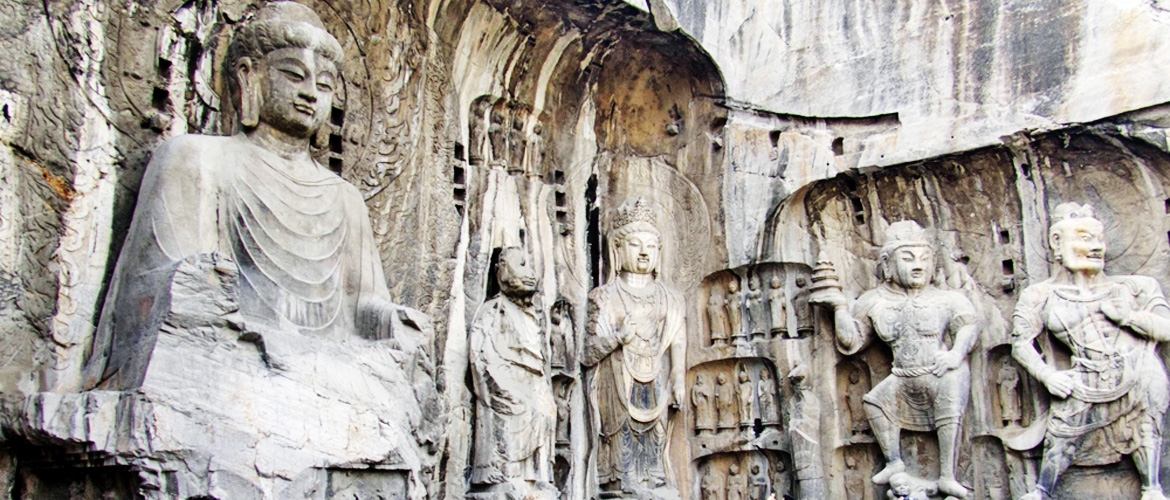
The UNESCO World Heritage Site of Longmen Grottoes is one of the Three Major Grottoes of China — the others being Mogao Grottoes in Dunhuang and Yungang Grottoes in Datong. The Longmen Grottoes are most famous for their incredible collection of Buddhist rock carvings and statues, which dates back to the Northern Wei Dynasty (5th–6th centuries).
Lunch is followed by a visit to White Horse Monastery – the oldest Buddhist monastery in China.
Afterwards, we travel to Xi’an by high-speed train (G3157, 16:46/18:13)
Day 13/Tue: Xi’an (B/L)
With a history dating back over 3,000 years, Xi’an served as China’s capital of several ruling dynasties including the Han (206 BCE – 220 CE) and the Tang (618 – 907). It is home to the famous Terracotta Army and the eastern terminus of the ancient Silk Road – a network of trade routes connecting China proper with regions as far as the Mediterranean beginning in the Second Century BCE.
We spend the morning visiting the Terracotta Army. Built on the excavation site, the museum is located 30 km east of the city. Designed to follow the first emperor of the Qin Dynasty (221-206 BCE) into eternity, the Terracotta Army represents one of the greatest archaeological discoveries of the 20th century.
After lunch we return to the city for a stroll on the ancient city wall. Declared a national treasure by the State Council in 1961, the wall (first built in 1370) encircles an area of 14 square kilometres. It runs 13.7 kilometres long and measures 12 metres in height with a base thickness between 15 to 18 metres.
Day 14/Wed: Xi’an – Chengdu (B/L/D)
Morning sightseeing begins at Shaanxi Provincial Museum. The modern, well-organized museum was completed in 1992 and traces the history of Xi’an from prehistory to the Qing dynasty (1644-1912). The extensive galleries and exhibitions offer the visitor an excellent introduction to the area that greatly improves understanding of the numerous historical sites in and around the city.
We then visit the grand mosque in the old town centre and the adjacent Muslim bazaar. The mosque was established in the 8th century but the majority of the complex was constructed in the Ming Dynasty (1368-1644). It was further expanded in the Qing Dynasty. Unlike most mosques in Middle Eastern or Arab countries, this mosque is completely Chinese in architectural style. It has neither domes nor traditional minarets.
This afternoon we ride the bullet train (G1975, 14:34/18:25) to Chengdu, the capital of populous Sichuan Province. The ancient city has a population of 14 million with half of that within the urban centre and the remainder in the surrounding districts. The fertile Chengdu Plain, on which Chengdu is located, is also known as “Country of Heaven”, a phrase also often translated as “The Land of Abundance”. The discovery of the Jinsha site suggests the area of Chengdu had become the centre of the Bronze Age Sanxingdui culture around the time of the establishment of the state of Shu, prior to its annexation by Qin in 316 BCE.
Day 15/Thu: Chengdu (B/L)
Morning sightseeing takes place at Chengdu Research Base of Giant Panda Breeding. The giant panda, unrelated to the red or lesser panda, is a bear native to south central China, living in mountainous regions. It is easily recognized by the large, distinctive black patches around its eyes, over the ears, and across its round body. Though it belongs to the order Carnivora, the panda’s diet is over 99% bamboo. The giant panda has an insatiable appetite for bamboo. A typical animal eats half the day – a full 12 out of every 24 hours – and relieves itself dozens of times a day. Giant pandas are solitary creatures. They have a highly developed sense of smell that males use to avoid each other and to find females for mating in the spring. After a five-month pregnancy, females give birth to a cub or two, though they cannot care for both twins. The blind infants, born fully white, weigh only 5 ounces (142 grams) at birth and cannot crawl until they reach three months of age.
The giant panda is a conservation-reliant species. Although no longer considered by the International Union for Conservation of Nature (IUCN) to be Endangered, the species is still classified as Vulnerable. Recent statistics show 637 pandas living in captivity with most of them inside China. The most authoritative estimate as of late 2022 puts the number of giant pandas living in the wilderness at 1864.
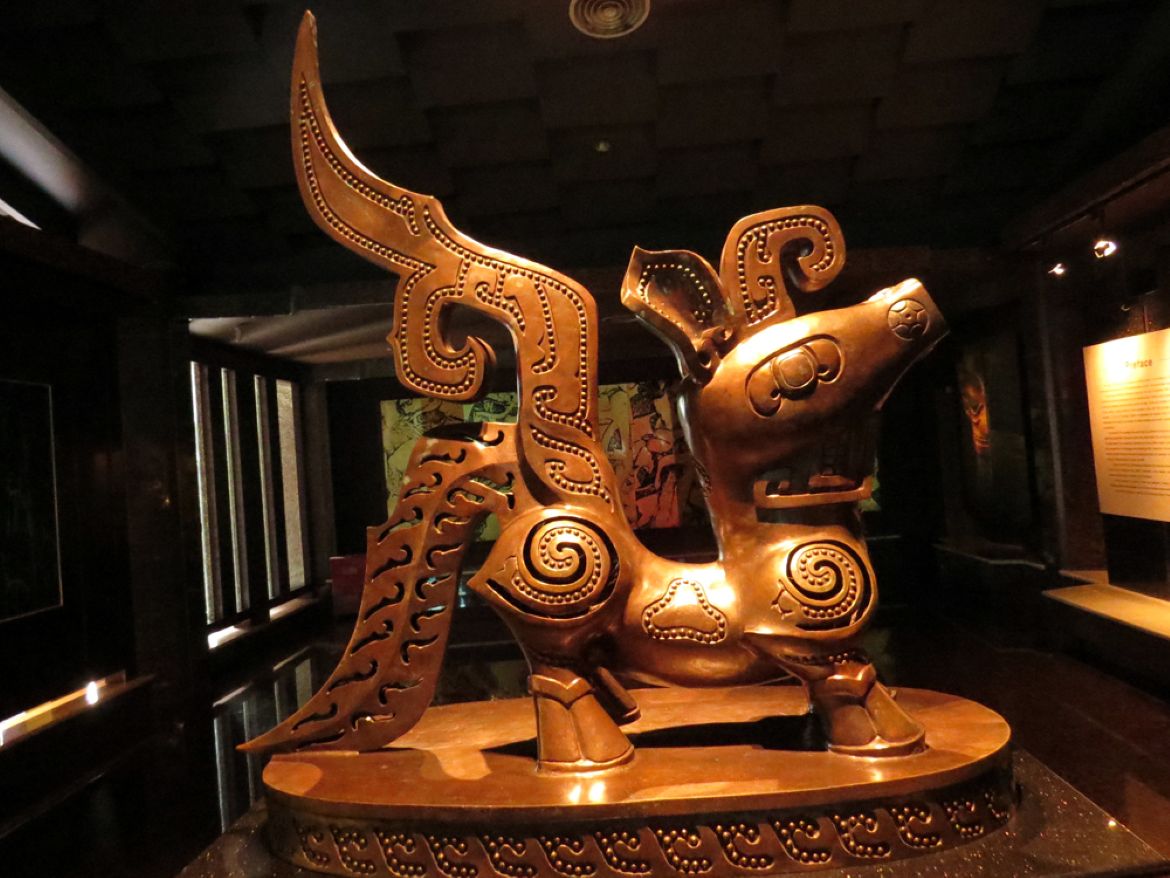
We spend most of the afternoon at Sanxingdui Museum. Located about 40km from Chengdu, Sanxingdui Museum showcases a mysterious, 4,000-year-old Bronze Age Shu civilization. Opened in 1997 with a major 2023 expansion, it houses thousands of artifacts, including iconic large bronze masks, standing figures, and the 12-foot “Tree of Life”. Unlike anything else in the Middle Kingdom, these haunting, otherworldly artifacts offer a profound encounter with an ancient culture that remains shrouded in mystery.
Day 16/Fri: Chengdu – Shanghai (B/L)
Free morning to explore on your own. We fly to Shanghai later in the day.
Day 17/Sat: Shanghai (B/L/D)
With a population close to 25 million, Shanghai is China’s largest city and a dynamic hub of global trade and cultural exchange. The city delights visitors from around the world with its futuristic skyline and historical landmarks.
We begin our day with a visit to Jade Buddha Temple located in an old neighbourhood. We then walk the famous Bund – a waterfront promenade with a riveting history.
After lunch, we stroll the historical People’s Park and adjacent People’s Square in the heart of the city. Originally part of the Shanghai Race Club first established in 1850, the park and the square are surrounded by world-class museums and shops, which attract millions of visitors each year.
We wrap up the day’s sightseeing with a tour of the exquisite Yu Garden in the old town centre.
Day 18/Sun: Shanghai (B)
Free day to explore on your own.
If you are interested in art and history, Shanghai Museum would be a great place to spend half a day. This museum houses a huge collection of precious national treasures. Shanghai Jewish Refugees Museum and Nanwaitan Fabric Market (high-end tailor shops) are also recommended.
Optional Suzhou Day Tour
After breakfast we ride the high-speed train (30-40 minutes) to Suzhou, an ancient city most famous for its gardens, ancient canals and silk industry. In the late 13th century a Venetian named Marco Polo visited Suzhou and was very impressed by what he saw. He vividly described the prosperous silk industry and dubbed Suzhou “Venice of the East” due to the small waterways crisscrossing the city.
Our full-day schedule takes in the historic Tiger Hill, Humble Administrator’s Garden, North Pagoda, a short canal cruise. We return to Shanghai by train in the afternoon.
The all-inclusive price with lunch starts from US$250 per person and requires a minimum of 2 participants to operate.
Day 19/Mon: Return Home (B)
Your memorable China tour comes to an end this morning. Transfer to the airport any time for return flight. Guests flying back to North America will arrive home the same day as departing from Shanghai after re-crossing the International Date Line.
| City | Nights | Hotel | Category |
| Beijing | 3 | New Otani Chang Fu Gong | Luxury/5 stars |
| Datong | 2 | Wyndham Datong Hotel | Luxury/5 stars |
| Taiyuan | 2 | Wyndham Taiyuan Hotel | Luxury/5 stars |
| Pingyao | 1 | name to advised* | Luxury boutique |
| Zhengzhou | 2 | Hilton Zhengzhou | Luxury/5 stars |
| Xi’an | 2 | Sheraton Xi’an North City | Luxury/5 stars |
| Chengdu | 2 | Taihe International Hotel | Luxury/5 stars |
| Shanghai | 3 | Amara Signature Shanghai | Luxury/5 stars |
* There is a number of luxury boutique hotels in Pingyao. Due to the small sizes of these properties, we need to maintain flexibility with our choice.
Dates & Prices
| Depart (Thu) |
Return (Mon) |
Land Only* CA$/US$ |
Single Supplement CA$/US$ |
| 2026 | |||
| 19-Mar | 06-Apr | $6790/$4990 | $2170/$1550 |
| 26-Mar | 13-Apr | $7070/$5199 | $2170/$1550 |
| 02-Apr | 20-Apr | $7280/$5350 | $2380/$1700 |
| 09-Apr | 27-Apr | $7450/$5450 | $2380/$1700 |
| 07-May | 25-May | $7450/$5450 | $2380/$1700 |
| 14-May | 01-Jun | $7450/$5450 | $2380/$1700 |
| 21-May | 08-Jun | $7250/$5290 | $2380/$1700 |
| 28-May | 15-Jun | $6870/$5050 | $2170/$1550 |
| 04-Jun | 22-Jun | $6870/$5050 | $2170/$1550 |
| 11-Jun | 29-Jun | $6870/$5050 | $2170/$1550 |
| 18-Jun | 06-Jul | $6870/$5050 | $2170/$1550 |
| 27-Aug | 14-Sep | $6940/$5100 | $2170/$1550 |
| 03-Sep | 21-Sep | $7280/$5350 | $2240/$1600 |
| 10-Sep | 28-Sep | $7280/$5350 | $2240/$1600 |
| 08-Oct | 26-Oct | $7520/$5490 | $2240/$1600 |
| 15-Oct | 02-Nov | $7520/$5490 | $2240/$1600 |
| 22-Oct | 09-Nov | $7280/$5350 | $2240/$1600 |
| 29-Oct | 16-Nov | $7280/$5350 | $2240/$1600 |
| 05-Nov | 23-Nov | $7070/$5200 | $2170/$1550 |
* Land Only price does NOT international airfare. Please contact us for a fare quote.
|
What the tour price includes:
|
What the tour price excludes:
See Terms & Conditions for more information. |