Colombo – Habarana – Sigiriya – Anuradhapura – Kandy – Ella – Galle – Colombo
This journey through Sri Lanka weaves together centuries of history, vibrant culture, and breathtaking scenery. Explore UNESCO World Heritage cities, majestic fortresses, and serene temples; wander through bustling markets and tranquil botanical gardens. Experience the warmth of local hospitality, sample aromatic spices during hands-on cooking classes, and relax in luxury hotels. From lush tea plantations and rainforests to golden coasts, each day offers rich encounters with friendly people, distinctive traditions, and some of the island’s finest cuisine.
Important Features
- Small group size – maximum 20.
- Experienced guides carefully selected by company owners.
- Premium hotel accommodations.
- Three meals a day featuring quality local & Western cuisine.
- Carefully curated cultural activities.
- No shopping stops.
TOUR ITINERARY
Meal Code: B = Breakfast / L = Lunch / D = Dinner
Day 1: Depart for Colombo
Depart from a city of your choice. Ask us about the best available airfare.
Day 2: Arrive in Colombo
Welcome to Sri Lanka! You will be met on arrival and transferred by private vehicle to the hotel. The balance of the day is at leisure.
Day 3: Colombo (B/L/D)
Colombo, Sri Lanka’s largest city and commercial centre, has been an important Indian Ocean trading port for centuries. Its architecture and neighbourhoods reflect successive periods of Portuguese, Dutch and British rule as well as the city’s modern development.
Our sightseeing today includes Colombo Fort, the historic and financial heart of the city; the lively Pettah Market; the National Museum; Gangaramaya Temple; and the 351.5-metre Lotus Tower, the tallest structure in Sri Lanka.
Day 4: Colombo – Habarana – Polonnaruwa – Habarana (B/L/D)
The morning drive to Habarana takes about 3½ hours (180 km).
After dropping off our luggage at the hotel, we drive about one hour (50 km) to Polonnaruwa, a UNESCO World Heritage Site and one of Sri Lanka’s best-preserved ancient cities. Polonnaruwa became the country’s second capital after Anuradhapura fell to the Cholas in 993. The city reached its height in the 12th century under King Parakramabahu I, who transformed it with palaces, temples, gardens and an extensive irrigation system. Today its impressive ruins also include Hindu monuments dating from the earlier Chola period.
Day 5: Habarana – Anuradhapura – Habarana (B/L/D)
After breakfast, we set off for an excursion to Anuradhapura, one of the great ancient cities of Sri Lanka.
Founded in the 4th century BC, Anuradhapura was the island’s first great capital and remained its political and religious centre for more than 1,000 years. The city is especially sacred to Buddhists because of the Sri Maha Bodhi, grown from a cutting of the original Bodhi tree under which the Buddha is believed to have attained enlightenment. The cutting was brought to Sri Lanka from India in the 3rd century BC by Sanghamitta, a Buddhist nun and daughter of Emperor Ashoka.
Anuradhapura flourished with magnificent stupas, monasteries, palaces and reservoirs before losing its position as the capital following the Chola invasion in the late 10th century. Today, its extensive ruins form one of Sri Lanka’s most important archaeological sites and have been protected as a UNESCO World Heritage Site since 1982.
After lunch, we continue to Mihintale, a mountain complex regarded as the birthplace of Buddhism in Sri Lanka. According to tradition, it was here in the 3rd century BC that the Buddhist monk Mahinda, son of Emperor Ashoka, met King Devanampiya Tissa and introduced him to Buddhism. We take part in a meditation session led by a local Buddhist monk before returning to Habarana.
Day 6: Habarana – Sigiriya – Habarana (B/L/D)
After breakfast, we depart for Sigiriya.
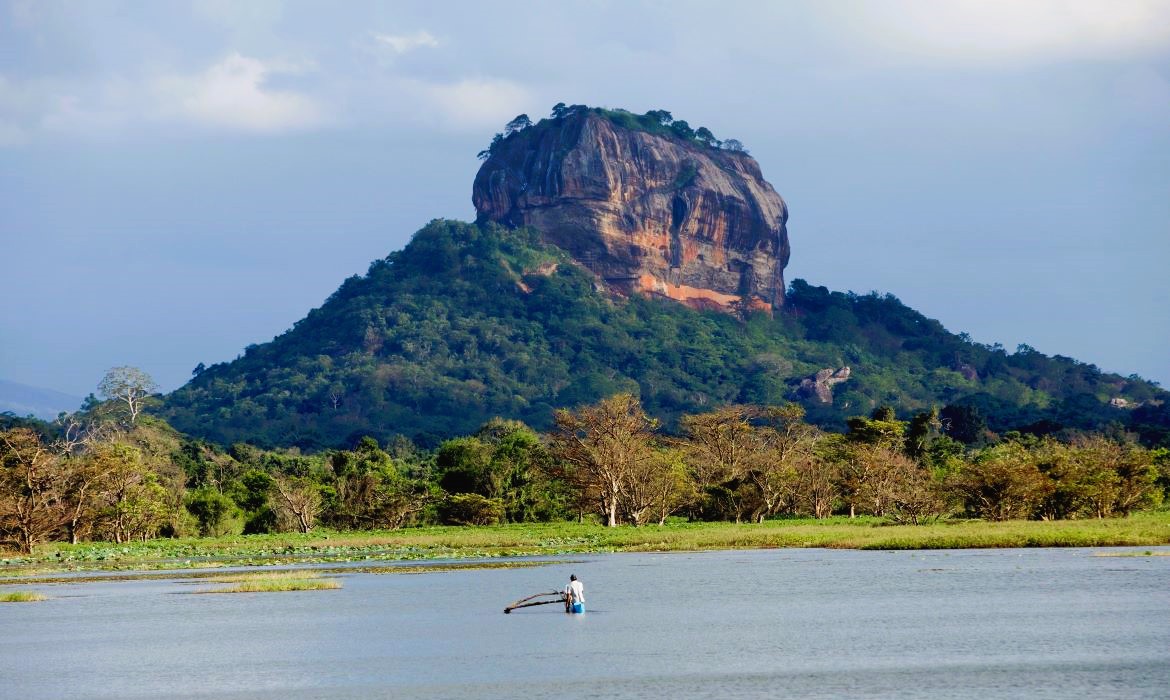
Rising about 180 metres above the surrounding plain, Sigiriya, or “Lion Rock,” is one of Sri Lanka’s most extraordinary archaeological sites. King Kassapa I established his capital here in the late 5th century, building a fortified royal complex on and around the massive granite rock. The site was inscribed as a UNESCO World Heritage Site in 1982.
At the base of the rock are moats, ramparts and landscaped gardens, while a series of stairways and galleries leads towards the summit. Along the way are the famous Sigiriya frescoes and the Mirror Wall. The enormous lion that once guarded the final ascent has largely disappeared, but its massive stone paws remain.
The summit, covering approximately four acres (1.5 hectares), once contained the royal palace complex. Today, its foundations, rock-cut features and large water pool remain, along with sweeping views over the surrounding countryside.
After returning to the hotel, we spend the rest of the day at leisure.
Day 7: Habarana – Dambulla – Kandy (B/L/D)
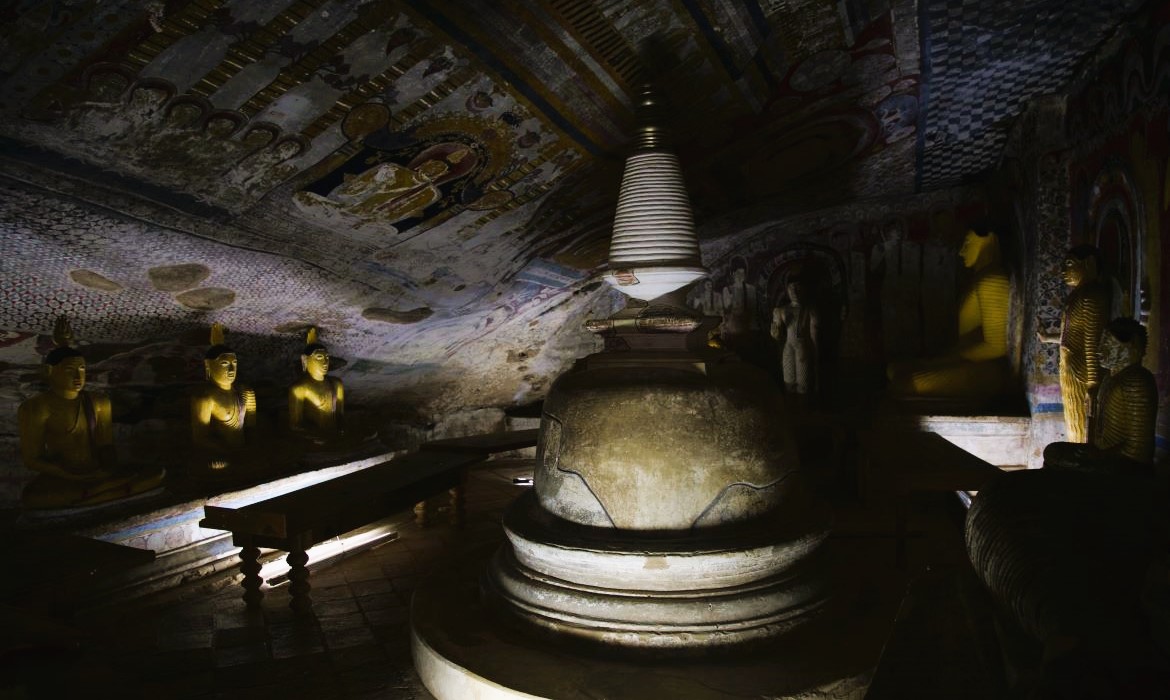
The morning drive to Kandy (115 km) includes a visit to the Dambulla Cave Temple, a UNESCO World Heritage Site and the largest and best-preserved cave-temple complex in Sri Lanka. The monastery dates back more than 2,000 years, when Buddhist monks occupied the natural caves. According to tradition, King Valagamba took refuge here in the 1st century BC and later converted the caves into a temple after regaining his throne.
The complex consists of five cave sanctuaries containing 157 statues and approximately 2,100 square metres of Buddhist murals. Successive Sri Lankan kings enlarged and embellished the temples over the centuries, leaving an extraordinary collection of religious art.
Upon arrival in Kandy, we visit Sri Dalada Maligawa, commonly known as the Temple of the Sacred Tooth Relic. The temple houses what is believed to be a tooth of the Buddha, preserved within seven nested caskets. The relic has played an important role in Sri Lankan history, as possession of it traditionally came to symbolize the right to rule the country. The temple is one of the most sacred places of Buddhist worship in Sri Lanka and forms part of the Sacred City of Kandy, a UNESCO World Heritage Site since 1988.
Day 8: Kandy – Nuwara Eliya – Ella (B/L/D)
This morning, we visit the Royal Botanic Gardens at Peradeniya. Covering 147 acres (59 hectares), the gardens contain more than 4,000 species of plants and are particularly noted for their collection of orchids, palms, spices and medicinal plants. Their history dates back to 1371, when the site was associated with the Kandyan royal court. The modern botanic garden was established under British administration in 1821.
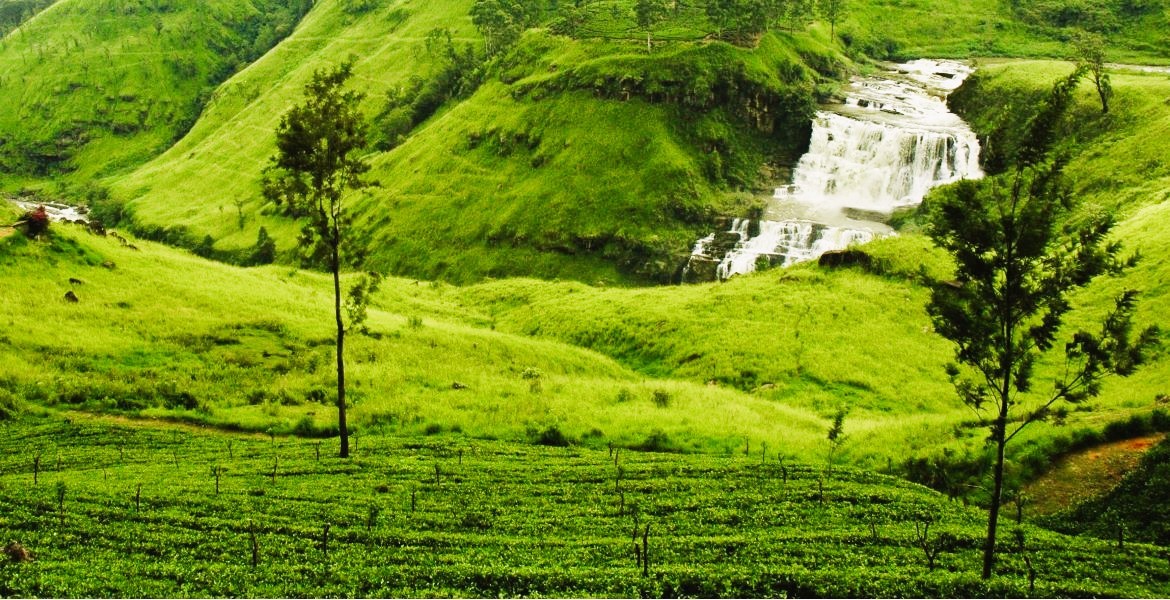
Afterwards, we board the train for Nanu Oya, a journey of approximately three to four hours through Sri Lanka’s scenic central highlands. The railway winds through mountains, tea plantations and forested valleys, with waterfalls and small hill-country communities along the way.
At Nanu Oya, we rejoin our private vehicle for the short drive to Nuwara Eliya. Set at an elevation of about 1,868 metres, Nuwara Eliya lies at the heart of one of Sri Lanka’s best-known tea-growing regions and is noted for its high-grown Ceylon teas. Its cool climate and British colonial-era buildings have given the town a character quite different from the tropical lowlands.
In the late afternoon, we continue by road to Ella, a scenic drive of approximately two hours.
Day 9: Ella – Galle (B/L/D)
Morning sightseeing begins with the Nine Arch Bridge, one of the best-known landmarks in Sri Lanka’s hill country. Built during the British colonial period, this graceful railway viaduct spans a forested gorge on nine masonry arches and remains in regular use today. We then visit Little Adam’s Peak, reached by a relatively easy walk through tea country and offering sweeping views over the surrounding hills and Ella Gap.
We also visit a tea plantation before taking part in a cooking class, followed by lunch.
In the afternoon, we drive approximately 200 km (3½ hours) to Galle on Sri Lanka’s southwest coast.
Galle owes much of its distinctive character to centuries of maritime trade and European colonial rule. Its historic centre is dominated by Galle Fort, first established by the Portuguese in the 16th century and extensively fortified by the Dutch in the 17th century. Today, the remarkably well-preserved fortified town is a UNESCO World Heritage Site.
Day 10: Galle (B/L/D)
This morning, we explore Galle Fort on foot. Within its massive ramparts lies a remarkably well-preserved colonial town, where European architecture was adapted to Sri Lanka’s tropical climate and local traditions. We walk along its narrow streets and ramparts and visit the Dutch Reformed Church, the National Maritime Museum and Galle Lighthouse.
In the afternoon, we visit the Japanese Peace Pagoda on Rumassala Hill. Built as a symbol of peace, the white stupa occupies a peaceful hillside setting overlooking the Indian Ocean and Galle Bay.
Day 11: Galle – Sinharaja Forest Reserve – Colombo (B/L/D)
After breakfast, we drive 90 km (2½ hours) to Sinharaja Forest Reserve.
A UNESCO World Heritage Site, Sinharaja is Sri Lanka’s last viable area of primary tropical rainforest and one of the country’s most important centres of biodiversity. More than 60% of its trees are endemic, and the forest provides habitat for an extraordinary variety of birds, mammals, butterflies, reptiles and amphibians found nowhere else in the world. Of particular note is its birdlife: 19 of Sri Lanka’s 20 endemic bird species have been recorded here.
We spend about two hours exploring the rainforest on foot before lunch. The forest is characterized by dense evergreen vegetation, streams, ridges and valleys, offering a striking contrast to the ancient cities, tea country and coastal landscapes experienced earlier in the tour.
After lunch, we continue by road to Colombo, a journey of approximately 3½ hours (120 km).
Day 12: Colombo – Home City (B)
Your Sri Lanka Discovery tour comes to an end this morning. You will be transferred by private vehicle to the airport in time for your home-bound flight.
HOTEL LIST
| City/Location | Night | Hotel | Category |
| Colombo – 1st stay | 2 | Shangri-La Colombo | Luxury |
| Habarana | 3 | Habarana Village by Cinnamon | Luxury |
| Kandy | 1 | Cinnamon Citadel | Luxury |
| Ella | 1 | 98 Acres Resort & Spa | Luxury |
| Galle | 2 | Radisson Blu Resort, Galle | Luxury |
| Colombo – 2nd stay | 1 | Shangri-La Colombo | Luxury |
Dates & Prices
Prices are based on double occupancy. See Terms & Conditions for cancellation penalty. Scroll down for price inclusions & exclusions.
| Depart (Sun) | Return (Thu) | Land Only CA$/US$ | Single Supplement CA$/US$ |
| 2026 | |||
| 22-Nov | 03-Dec | $5675/$4095 | $2191/$1599 |
| 29-Nov | 10-Dec | $5675/$4095 | $2191/$1599 |
| 2027 | |||
| 10-Jan | 21-Jan | $5995/$4295 | $2191/$1599 |
| 17-Jan | 28-Jan | $5995/$4295 | $2191/$1599 |
| 24-Jan | 04-Feb | $5995/$4295 | $2191/$1599 |
| 31-Jan | 11-Feb | $5995/$4295 | $2191/$1599 |
| 07-Feb | 18-Feb | $5995/$4295 | $2191/$1599 |
| 14-Feb | 25-Feb | $5995/$4295 | $2191/$1599 |
| 10-Mar (Wed) | 21-Mar (Sun) | $5995/$4295 | $2191/$1599 |
Know Before You Go
Passport
Your passport must have at least one blank visa page and be valid for at least six months from the date of arrival in Sri Lanka.
Visa
Canadian citizens travelling to Sri Lanka for tourism are required to obtain an Electronic Travel Authorization (ETA) before arrival. Effective May 25, 2026, Canadians are eligible for a tourist ETA free of charge for stays of up to 30 days. Please apply through the official Sri Lankan government ETA website (https://eta.gov.lk/) and avoid any fee-charging third parties.
Best Time to Visit Sri Lanka
The best time to visit Sri Lanka depends on the region and interests. Generally, the finest weather is from December to March, especially on the south and west coasts and in the central highlands. For those wishing to explore the north and east coasts, the best months are April to September, when those regions are sunnier and drier.
The southwest monsoon (May to September) brings rain mainly to the south and west, while the northeast monsoon (October to January) affects the north and east.
Festivals
Major Sri Lankan festivals include Duruthu Perahera (January), Sinhalese and Tamil New Year (April), Vesak Festival (May), and Kandy Esala Perahera (July/August).
Wildlife Highlights
These include whale watching (November-April), elephant gathering in Minneriya National Park (August-September), birdwatching (December-March), and leopard spotting in Yala National Park (December-March).