
Beijing – Xian – Chengdu – Lhasa – Shigatse – Kathmandu – Chitwan – Pokhara – Kathmandu – Thimphu – Punakha – Phobjikha Valley – Paro – Bangkok
ITINERARY
Meal Code: B = breakfast / L = lunch / D = dinner
Day 1/Thu: Departing for Beijing
The trip starts with your transpacific flight departing from a city of your choice. You’ll lose a day upon crossing the International Date Line.
Day 2/Fri: Arrival in Beijing
Meet the driver on arrival for transfer to the hotel. You’ll have the remainder of the day at leisure. The guide will get in touch with you tonight.
For guests who have been to Beijing and Xian, alternatives itineraries can be arranged upon request. You may also join the tour in Chengdu and fly to Lhasa with the group.
Day 3/Sat: Beijing (B/L/D)
We begin our sightseeing today at the Forbidden City. Officially known as the Palace Museum, the Forbidden City was the place where the emperors of the Ming (1368-1644) and Qing (1644-1912) dynasties lived and carried out their administration. The complex consists of 980 buildings and covers 72 hectares or 180 acres. It exemplifies traditional Chinese palatial architecture and has influenced cultural and architectural developments in East Asia and elsewhere.
Afternoon sightseeing takes place at the Temple of Heaven. Situated in southeastern Beijing, the Temple of Heaven is China’s largest extant sacrificial temple where, during the Ming and Qing Dynasties, the emperors conducted the elaborate and most exalted sacrifices addressed to “the Supreme Ruler of the Universe”. Occupying 2.73 square kilometres (roughly 1,700 by 1,600 metres), the area of the Temple of Heaven is more than twice that of the Forbidden City.
Today we enjoy a delicious dinner at a popular Peking Roast Duck restaurant.
Day 4/Sun: Beijing (B/L)
After an early breakfast we embark on an excursion to the legendary Great Wall at Mutianyu, 75 km northeast of the city.
Zigzagging over 6,000 kilometres from east to west along undulating mountains, the Great Wall was built to hold off tribal invaders from the north. As history shows, the Wall failed the Chinese rulers miserably. This is particularly true in the case of Kublai Khan, whose cavalrymen swept across China from the Mongolian steppe and ushered in a new dynasty known as the Yuan (1279-1368). Construction of the earliest sections of the Wall started in the 7th century BCE. A major renovation started with the founding of the Ming Dynasty in 1368 and took 200 years to complete. The wall we see today in Beijing is almost exactly the result of this effort.
Upon returning to the city in the afternoon, we visit a traditional hutong neighbourhood. Hutong refers to an ancient alleyway with siheyuan or ”4-sided courtyard house” on both sides. The name hutong dates back to the Yuan Dynasty (1279 – 1368 CE). According to some experts, the word originated from the Mongolian language, in which it is pronounced as “hottog” and means “well”. In ancient times, people tended to gather and live around wells. Therefore, the original meaning of hutong should be “a place where people live around.”
Day 5/Mon: Beijing – Xi’an (B/L/D)
This morning we visit the Summer Palace, a well-preserved UNESCO World Cultural Heritage Site. The imperial resort was first named Garden of Clear Ripples, which was burnt down by the allied forces of Great Britain and France in 1860 at the end of the Second Opium War (often referred to as the Arrow War by the British). Reconstruction started 25 years later and was completed in 1895 when the name was changed to Yi He Yuan (Garden of Good Health and Harmony). The design gives prominence to Longevity Hill, as well as Kunming Lake south of the hill. The sprawling complex covers an area of 290 hectares and the buildings inside consist of over 3,000 bays.
After a light lunch, we travel to Xi’an by high-speed train (#G87, 14:00/18:23). The 4-hour-23-minute rail journey through fertile farmland dotted with villages provides the visitor with an excellent way to enjoy the beautiful countryside. In the past 20 years China has been on a building spree expanding the country’s rail network and upgrading existing railways. Its high-speed rail service rivals France’s TGV and Japan’s “shinkansen” in terms of safety, speed, comfort and punctuality.
Day 6/Tue: Xi’an (B/L)
With a history dating back over 3,000 years, Xi’an served as China’s capital during several ruling dynasties including the Han (206 BCE – 220 CE) and the Tang (618 – 907). It is home to the famous Terracotta Army and the eastern terminus of the ancient Silk Road, a network of trade routes connecting China proper with regions as far as the Mediterranean beginning in the second century BCE.
We spend the morning visiting the Terracotta Army. Built on the excavation site, the museum is located 30 km east of the city. Designed to follow the first emperor of the Qin Dynasty (221-206 BCE) into eternity, the Terracotta Army represents one of the greatest archeological discoveries of the 20th Century.
After lunch we return to the city for a stroll on the ancient city wall. Declared a national treasure by the State Council in 1961, the wall (first built in 1370) encircles an area of 14 square kilometres. It runs 13.7 kilometres long and measures 12 metres in height with a base thickness between 15 to 18 metres.
Day 7/Wed: Xi’an – Chengdu (B/L/D)
Morning sightseeing begins at Xi’an Museum, where thoughtfully curated exhibits and tranquil gardens offer an engaging introduction to the city’s rich history as a former imperial capital and Silk Road gateway.
Within the same grounds, visit the graceful Little Wild Goose Pagoda, a serene Tang Dynasty landmark that has stood for over 1,300 years. Its elegant simplicity and peaceful setting provide a glimpse into Xi’an’s Buddhist heritage.
We then visit the grand mosque in the old town centre and the adjacent Muslim bazaar. The mosque was established in the 8th century but the majority of the complex was constructed in the Ming Dynasty (1368-1644). It was further expanded in the Qing Dynasty. Unlike most mosques in Middle Eastern or Arab countries, this mosque is completely Chinese in style. It has neither domes nor traditional minarets.
This afternoon we ride the bullet train (G1975, 14:34/18:25) to Chengdu, the capital of populous Sichuan Province. The fertile Chengdu Plain, on which Chengdu is located, is also known as “Country of Heaven”, a phrase also often translated as “The Land of Abundance”.
Day 8/Thu: Chengdu (B/L)
Morning sightseeing takes place at Chengdu Research Base of Giant Panda Breeding. The giant panda is a conservation-reliant species. Although no longer considered by the International Union for Conservation of Nature (IUCN) to be Endangered, the species is still classified as Vulnerable. Recent statistics (late 2022) shows 637 pandas living in captivity with most of them inside China. The most authoritative estimate as of late 2022 puts the number of giant pandas living in the wilderness at 1864.
We spend most of the afternoon at Jinsha Museum. In February 2001, construction workers chanced upon a significant archaeological discovery in modern China. The discovery led to the naming of Jinsha culture (1200 – 650 BCE) and a museum was erected at the excavation site. Jinsha culture flourished around 1000 BCE and shares similarities in burial objects with the Sanxingdui site located 50 km from Chengdu.
Day 9/Fri: Chengdu – Lhasa (B/L/D)
We board an early morning flight (2 hours 30 minutes) for Lhasa and spend the remainder of the day relaxing to get acclimated to the high altitudes.
Situated in a wide, mountain-fringed valley on the north bank of the Kyichu River, Lhasa (elevation 3,650 m) is a rapidly expanding city with a population around 870,000 as of late 2022. An important settlement for well over one thousand years, Lhasa was originally called Rasa, but was renamed by King Songtsen Gampo in the 7th century when he moved his capital here from the Yarlung Valley. Following the collapse of the Yarlung dynasty two centuries later, power dispersed among local chieftains and the city lost its pre-eminence. It was not until the 17th century, with the installation of the Fifth Dalai Lama as ruler by Gushri Khan, a Mongolian prince and later leader of the Khoshut Khanate, that Lhasa once again became the seat of government.
Day 10/Sat: Lhasa (B/L)
Morning visit to Norbulingka, literally meaning jeweled park. First built in 1755, Norbulingka covers an area of 89 acres and served as the traditional summer residence of the successive Dalai Lamas. A short distance to the southwest of the Potala Palace, Norbulingka forms part of a UNESCO World Heritage Site collectively known as the Historic Ensemble of the Potala Palace.
This afternoon we tour the grand Sera Monastery, where lively debates held every day except Sunday between resident monks often draw a large audience. Sera Monastery is recognized as one of the “great three” Gelug university monasteries of Tibet together with Ganden Monastery and Drepung Monastery.
Day 11/Sun: Lhasa (B/L)
This morning we visit the Potala Palace. This was the chief residence of the Dalai Lama until the 14th Dalai Lama fled to India during the 1959 Tibetan uprising. Now a museum, the palace is named after Mount Potalaka, the mythical abode of the bodhisattva Avalokiteśvara. The 5th Dalai Lama started its construction in 1645 after one of his spiritual advisers pointed out that the site was ideal as a seat of government, situated as it is between Drepung and Sera monasteries and the old city of Lhasa. The palace sits on the site of an earlier fortress built by King Songtsen Gampo. The main building measures 360 metres east-west and 140 metres north-south. Thickness of the exterior granite walls varies between 2 and 5 metres.
Afternoon sightseeing takes place at Jokhang Temple, one of the oldest Buddhist buildings in Tibet and a remarkable combination of Tibetan, Indian, Nepalese and Han Chinese architectural styles. No visit to Jokhang Temple is complete without checking out the Barkhor Street bazaar outside the temple.
Day 12/Mon: Lhasa – Gyantse – Shigatse (B/L/D)
Following breakfast, we drive along the Southern Route to Gyantse (265 km).
Highlights of the scenic drive include Kambaba Pass (4700 metres/15416 feet above sea level) and the sacred Yamdrok Lake. Every summer, throngs of Tibetan pilgrims come to the lake to pray for blessings from the lake goddess.
Afternoon sightseeing in Gyantse takes in the Fortress of Gyantse Dzong and Pelkhor Choede. We then continue on to Shigatse (90 km) in late afternoon arriving at the second largest city in Tibet around dinnertime.
Day 13/Tue: Shigatse – Lhasa (B/L)
This morning we tour Tashilhunpo Monastery, the religious and administrative headquarters of the Panchen Lama, the paramount leader of the Yellow Sect of Tibetan Buddhism. A visit to a local Tibetan family is also on the itinerary.
After lunch we drive back to Lhasa via a different route – the better-paved Northern Route (295 km). Vast pastureland, barren mountain slopes, snow-capped peaks, blue skies, white clouds, the scant population, and ubiquitous prayer flags – these images combine to conjure a sense of solitude and mystery.
Day 14/Wed: Lhasa (B)
Free day to explore on your own. For a small fee, we can organize a visit to a local elementary school or a hospital practicing traditional Tibetan medicine.
Day 15/Thu: Lhasa – Kathmandu (B/D)
We travel to Kathmandu by air (2 hours 40 minutes) today. Meet your guide on arrival at the airport and transfer to the hotel. The rest of the day is at leisure.
Day 16/Fri: Kathmandu (B/L/D)
Kathmandu stands at an elevation of approximately 1,350 meters in the bowl-shaped valley, surrounded by four major mountains. The city’s rich history dates back to 2000 years ago. Its religious affiliations are dominantly Hindu, followed by Buddhism and other beliefs. Nepali is the common language.
This morning, we visit Kopan Monastery and Boudhanath Stupa. Kopan Monastery sits on top of the Kopan hill just north of the ancient Buddhist town of Boudhanath. Dominated by a magnificent bodhi tree, the hill was once the home of the astrologer to the king of Nepal. Now, it houses a monastery in the Gelug tradition of Tibetan Mahayana Buddhism under the guidance of Lama Zopa Rinpoche. There are 360 monks from all areas of Nepal and Tibet with ages ranging from seven to sixty years old.
The ancient Boudhanath stupa, on top of a massive mandala, is one of the largest spherical stupas in Nepal. It was built on the ancient trade route from Tibet to the Kathmandu Valley. Thousands of pilgrims gather daily to make a kora (ritual circumnavigation) of the dome. In the evening the whole place lights up with butter lamps and the wafting smell of sage gives a calming effect. The plaza surrounding the stupa is open for people of all religions. Tibetan monks, the elderly, and other devotees can be seen spinning prayer wheels, chanting mantras, or just strolling in silence around the monument.
After lunch we visit Patan Durbar Square, just 5 km south of the Kathmandu. Patan is one of the three royal cities in the Valley, known for its various Buddhist and Hindu temples and over 1000 monuments featuring the finest wood and stone carvings. After the devastating 2015 earthquake, Patan was first to rise above the rubble and open to tourists.
Also on our schedule today is an interactive session with an ex-Kumari (Living Goddess). A Kumari is believed to be the living incarnation of the goddess Taleju (also known as Durga). The Kumari is selected by a council from Newari people (native inhabitants of Kathmandu Valley).
Day 17/Sat: Kathmandu (B/L)
After breakfast, we drive to Bhaktapur, 14 km east of Kathmandu.
Bhaktapur is renowned for its art, culture, and indigenous lifestyle. The city is like an open museum with innumerable monumental masterpieces. Nyatapola Temple at Taumadhi Square is the country’s tallest pagoda temple. After viewing the most fascinating structures at Bhaktapur’s Durbar Square, we will have an opportunity to observe and try our hands at pottery making.
Day 18/Sun: Kathmandu – Chitwan (B/L/D)
This morning we drive through the winding gorges and across fast flowing rivers to the renowned Chitwan National Park.
The National Park lies in the Inner Terai lowlands and spreads over an area of 932 sq km. It’s home to numerous species of mammals, amphibians, reptiles, and birds. Some endangered wildlife species found here include the one-horned rhinoceros, Royal Bengal tiger, wild elephant, four-horned antelope, leopard, sloth bear, rhesus monkey, grey langur monkey and many other smaller animals. Also found here are cobras, kraits, pythons, crocodiles, and freshwater dolphins.
After lunch at the Jungle Lodge, we visit the small village of the Tharu ethnic group. In the evening, experience the vibrant traditional cultural performances of the Tharu community.
Day 19/Mon: Chitwan (B/L)
Embark on a full day of jungle activities, including an early morning jungle safari by jeep, canoeing and bird watching. Explore the park’s rich flora and fauna and penetrate through dense grasslands to view wildlife in their natural habitat.
Day 20/Tue: Chitwan – Pokhara (B/L)
After breakfast, transfer to Pokhara, the third largest city in Nepal and the starting point for most of the treks in the Annapurna area. Situated at an altitude of 872 m above sea level and 200 km west of Kathmandu Valley, Pokhara is a remarkable place of natural beauty. The serenity of the lakes and the magnificence of the Himalayas rising behind them create an ambience of peace and magic.
Later in the evening, enjoy a boat ride at Phewa Lake followed by a visit of Tal Barahi Temple located on an island in the middle of the lake.
Day 21/Wed: Pokhara (B/L)
Embark on an early morning excursion to Sarangkot for a stunning view over the Himalayas. Walk back through farms and forest for breakfast.
Take a momo-making cooking class. Momos are a type of steamed filled dumpling popular in Tibetan and Nepali cuisine. The afternoon is at leisure.
Day 22/Thur: Pokhara – Kathmandu (B/L/D)
After breakfast, we drive back to Kathmandu and transfer to hotel.
Later today we visit Swayambhunath and Pashupatinath Temple.
Perched on top of a conical hill, Swayambhunath (also known as Monkey Temple) is a white dome with a glittering golden spire visible from all sides of the valley for many miles. The 2,500-year-old stupa is a UNESCO World Heritage Cultural Site. It is considered the most enigmatic of all the holy shrines in the Kathmandu Valley.
Also a UNESCO World Culture Heritage Site, Pashupatinath Temple is more than just a religious destination. It is a combination of religion, art and culture. Hundreds of rituals are performed here every day.
Following dinner, we have an interaction with a Sherpa and listen to his stories of climbing Mount Everest.
Day 23/Fri: Kathmandu (B)
Free day for shopping or exploring on your own.
Day 24/Sat: Kathmandu – Paro – Thimphu (IM/L/D)
Transfer to the airport for the 1-hour morning flight to Paro. We transfer to Thimpu immediately on arrival. During the one-hour drive to Bhutan’s capital, the visitor can’t help but marvel at the well protected environment.
After lunch we visit the Memorial Chorten (temple) built in memory of the late 3rd king. Afterwards, we proceed to Changangkha Lhakhang, an ancient temple offering a panoramic view of Thimphu Valley. Later in the afternoon, we tour Tashichho Dzong, a fortress that houses the throne of the king and serves as the seat of the Bhutanese government.
Day 25/Sun: Thimphu (B/L/D)
In the morning we visit a local market where residents from the surrounding villages come to buy and sell. This is followed by a tour of the School of Arts and Crafts where students learn 13 different forms of traditional arts including sculpture and furniture making.
Afternoon schedule includes the National Museum, National Library, and Bhutan Post Office where you can order stamps of your own design!
Day 26/Mon: Thimphu – Punakha (B/L/D)
After breakfast we drive three hours to subtropical Punakha, the former capital of Bhutan. On a clear day, the Dochula Pass en route provides a spectacular view of the surrounding snow-capped mountains. Prior to arrival at the hotel, we hike through lush rice paddies to Chimi Lhakhang (temple of fertility and phallus worship) located on a hilltop.
If time allows, we’ll also visit a school today.
Day 27/Tue: Punakha (B/L/D)
We begin the day with a visit to Punakha Dzong, a historical fortress exemplifying the best of traditional Bhutanese architecture. After the visit, we go for a hike, stopping at lookout points for bird’s-eye views of the magnificent dzong.
Day 28/Wed: Punakha – Phobjikha Valley (B/L/D)
After breakfast we drive 2 hours further east to Phobjikha Valley. The scenic drive is simply breathtaking. This valley is paradise for nature lovers and hosts a protected sanctuary for the endangered black-necked cranes which migrate here every winter.
After lunch at a farmer’s house, we spend two and half hours hiking from the bottom of the valley to the hilltop Gangtey Monastery. A monk-led meditation session is arranged.
Day 29/Thu: Phobjikha Valley – Paro (B/L/D)
Free morning to explore on your own. We drive back to Paro (5 hours) after lunch.
Day 30/Fri: Paro (B/L/D)
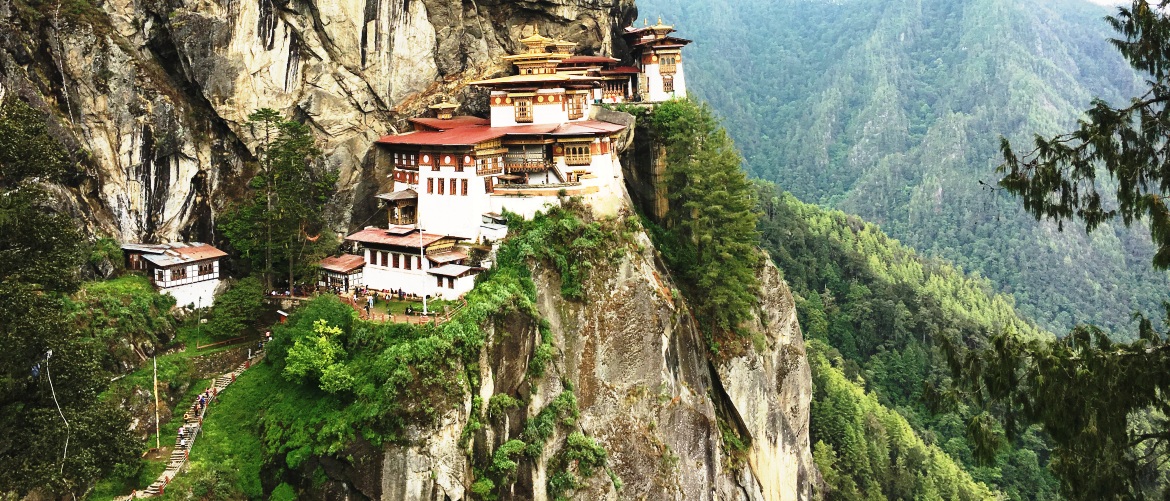
Paro Taktsang, better known as Tiger’s Nest, is probably Bhutan’s most prominent Buddhist monastery. It is situated on a steep cliff side overlooking Paro Valley. The hike up to the monastery this morning takes 3 hours.
Afternoon sightseeing at Rinpung Dzong. The dzong is a practising monastery that also serves as the government offices of the district.
Day 31/Sat: Paro – Bangkok (B)
Transfer to the airport for your flight to Bangkok. Walk to the airport hotel on your own.
You may also fly to Singapore or other cities if you do not want to end the tour in Bangkok. We can provide assistance on the flight booking.
Day 32/Sun: Bangkok (B)
Free day for you to relax or explore on your own. Optional city tours in Bangkok or beach holidays in Thailand can be arranged upon request.
Day 33/Mon: Bangkok – Home City (B)
Your Himalayan Adventure tour ends this morning. Transfer to the airport any time for your return flight. Guests flying back to North America will regain a day upon re-crossing the International Date Line, thus arriving home the same day as departing from Kathmandu.
Hotel List
| City/Location | Nights | Hotel | Category |
| Beijing | 3 | New Otani Chang Fu Gong | Luxury |
| Xian | 2 | Sheraton Xi’an North City | Luxury |
| Chengdu | 2 | Chengdu Taihe International | Luxury |
| Lhasa | 3 | InterContinental Lhasa | Luxury |
| Shigatse | 1 | Hilton Shigatse | Luxury |
| Lhasa | 2 | InterContinental Lhasa | Luxury |
| Kathmandu – 1st stay | 3 | Hotel Radisson | Luxury |
| Chitwan | 2 | Kasara Resort | Luxury |
| Pokhara | 2 | Fishtail Lodge | Luxury |
| Kathmandu – 2nd stay | 2 | Hotel Radisson | Luxury |
| Thimphu | 2 | Terma Linca | Luxury |
| Punakha | 2 | Dhensa Boutique Resort | Luxury |
| Gangtey | 1 | Gangtey Lodge | Luxury |
| Paro | 2 | Le Meridien | Luxury |
| Bangkok | 2 | Chengdu Taihe International | Luxury |
Dates & Prices
Prices are based on double occupancy. See Terms & Conditions for cancellation penalty. Scroll down for price inclusions & exclusions.
| Depart (Thu) |
Return (Mon) |
Land Only CA$/US$ |
Single Supplement CA$/US$ |
| 2026 | |||
| 02-Apr | 04-May | $19,995/$14,595 | $6,700/$4,890 |
| 14-May | 15-Jun | $19,995/$14,595 | $6,700/$4,890 |
| 10-Sep | 12-Oct | $19,995/$14,595 | $6,700/$4,890 |
| 08-Oct | 09-Nov | $19,995/$14,595 | $6,700/$4,890 |
| 2027 | |||
| 08-Apr | 10-May | $19,995/$14,595 | $6,700/$4,890 |
| 06-May | 07-Jun | $19,995/$14,595 | $6,700/$4,890 |
| 13-May | 14-Jun | $19,995/$14,595 | $6,700/$4,890 |
| 02-Sep | 04-Oct | $19,995/$14,595 | $6,700/$4,890 |
| 07-Oct | 08-Nov | $19,995/$14,595 | $6,700/$4,890 |
**This departure has a modified itinerary. Please contact us for details.
|
What the tour price includes:
|
What the tour price excludes:
See Terms & Conditions for more information. |
Passport
A passport with at least two (2) blank visa pages and six (6) months validity at the end of the tour is required. You’ll also need one photo of passport type (2×2 inches) for this trip but please bring an extra one just in case.
Chinese visa and Tibet entry permit
Chinese visa is required for US citizens. Information will be provided. Laurus Travel will take care of your Tibet entry permit.
Canadians, Australians and UK citizens can travel to China visa-free for up to 30 days.
Nepal Electronic Travel Authorization (ETA)
Effective from 25 August 2023, the Government of Nepal has introduced ETA in place of visa stickers/handwritten visas. A traveller should present the ETA at an immigration desk at the entry points in Nepal where the ETA will be converted into a corresponding visa, and the printed visa will be affixed on the passport. ETA is valid up to 6 months from the date of issuance. https://nepaliport.immigration.gov.np/eta-visa-processing
Bhutan Tourist Visa
Laurus Travel will take care of your application. You are not required to do anything on this.
Health & Immunization
You are not required of any inoculation certificate to enter the above countries. However, we suggest you visit your family physician or a travel clinic to determine what precautions you should take. We recommend inoculation shots for hepatitis A and suggest that you check out advice provided by the US CDC and Health Canada.
Tap water is safe to drink in Singapore. It may not be the case in Nepal and Bhutan. Ask for bottled water when eating in restaurants in these countries. Also, try to avoid uncooked food. Even if the food you eat is clean, you may still experience an upset stomach or diarrhea due to ingredients your stomach is not used to. Bottled water is readily available for purchase, but when buying bottled water from street vendors (especially at tourist sites), make sure the cap is properly sealed because some vendors may be selling tap water in recycled bottles. The hotels also provide bottles per room per day.
Always carry a roll of toilet paper and a bottle of hand sanitizer containing more than 60% alcohol, no matter where you go.
Money
Major credit cards are accepted throughout the above countries and can be used for major purchases. Purchases must be made in local currencies. You may be able to withdraw cash from local ATMs using your home bank issued bank card but we strongly advise you bring a few hundred US dollars.
The US dollar bills you bring in must be in near mint condition. Any stain or marking or missing corner would result in rejection by the local banks and currency dealers.
You do not need to get any local currency prior to arrival.
Currency
Tibet: Chinese Yuan (CNY)
Nepal: Nepalese Rupee (NPR)
Bhutan: Bhutanese Ngultrum (NU)