
| China visa not needed for this tour! |
Seoul – Busan – Gyeongju – Seoul – Beijing – Xi’an – Shanghai
This South Korea & China tour allows you to experience the perfect blend of ancient traditions and modern marvels the countries have to offer. From bustling cities to serene temples and breathtaking landscapes, this 15-day South Korea & China Tour invites you to immerse yourself in the rich cultures and beauty of two truly captivating destinations.
Important Features
- Small group size (average 15, maximum 20)
- Expert local guides
- Luxury (5 stars) hotel accommodations
- Quality local and Western meals at non-tourist restaurants
- Special Korean BBQ & Beijing roast duck dinners
- No annoying forced shopping of any kind.
- Excursion to the Demilitarized Zone near Seoul
- Great Wall visit at Mutianyu including cable car rides
TOUR ITINERARY
Meal Code: B = breakfast / L = lunch / D = dinner
Day 1: Departing for Seoul
Your South Korea & China vacation begins with international flight departing from a city of your choice. The tour price doesn’t include international airfare.
Day 2: Arrival in Seoul
Upon arrival, transfer to the centrally located hotel on your own, which can be easily done by taxi, airport limousine bus or airport express train. The 50 km cab ride from Incheon International Airport costs between 70,000 and 100,000 Korean Won ($50-$75 US) including expressway toll charge. The Airport Railroad Express train between the airport and Seoul Station costs 9,000 Won ($7 US); from Seoul Station, taking a cab to the hotel costs just a few dollars. The deluxe limousine bus from the airport to the hotel costing 18,000 won ($14 US) may be an ideal choice depending on your flight schedule.
Day 3: Seoul – Busan (B/L)
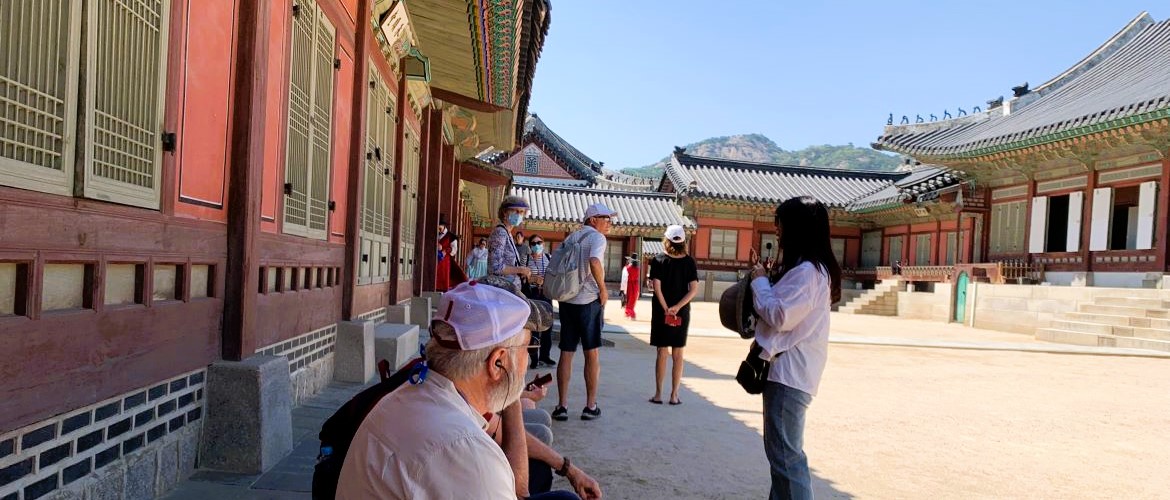
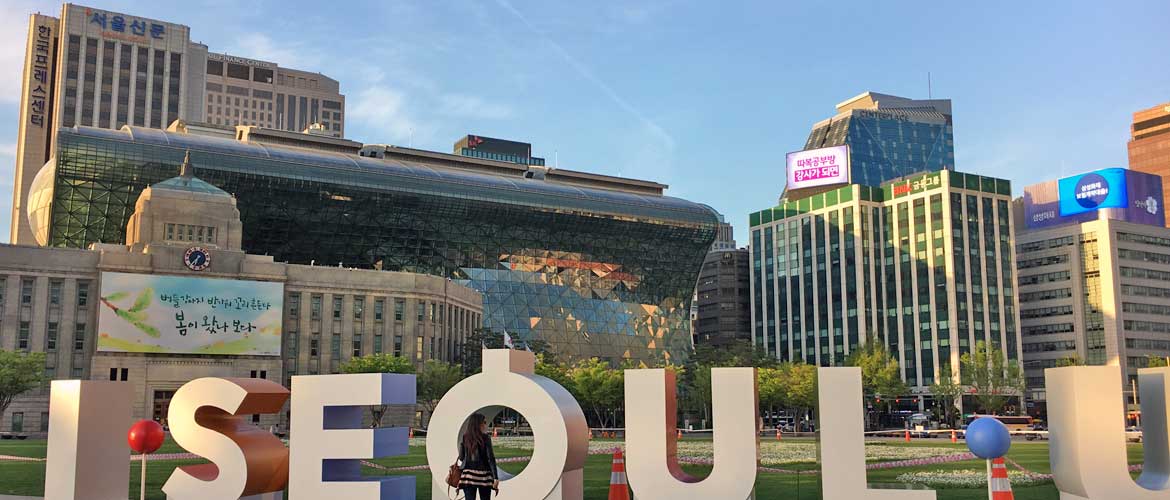
Seoul, the capital of South Korea, is a huge metropolis where modern skyscrapers, high-tech subways and pop culture meet Buddhist temples, palaces and street markets.
Our sightseeing today includes Gyeongbok Palace and Bukchon Hanok Village (traditional residential area on a hill inside the city).
The late afternoon train to Busan (KTX047, 16:28/18:59) takes 2 hours 31 minutes.
Day 4: Busan (B/L)
Busan, sometimes spelled as Pusan, is the largest port and second largest city in South Korea with a current population around 3.5 million. The city is known for its beaches, mountains, temples, and long history of trade and cultural exchange with Japan.
Today’s sightseeing begins with a visit to United Nations Memorial Cemetery. Established in January 1951, the 35-acre burial ground contains 2,300 graves of fallen soldiers who fought on the side of the United Nations during the Korean War (Jun 25, 1950 – Jul 27, 1953). The majority of the interred soldiers were from the Commonwealth of Nations including the United Kingdom (886), Canada (378), Australia (281), New Zealand (34) and South Africa (11). A South Korean guard of honour carries out flag ceremonies daily.
We then proceed to Jagalchi fish market, the largest seafood market in South Korea. Today’s schedule ends with a leisurely walk at Haeundae Beach.
Day 5: Busan – Gyeongju – Seoul (B/L)
Following breakfast we drive 100 kilometres northeast to Gyeongju. The city was the capital of the 1,000-year-long Silla dynasty and possesses extensive remains to prove its cultural and historical significance.
Our sightseeing in Gyeongju begins at the 8th-century Bulguksa, a magnificent Buddhist temple complex featuring stone pagodas, a series of wooden buildings on raised stone terraces, and a large bronze Buddha. A masterpiece of the golden age of Buddhist art in the Silla kingdom, the temple is classified as Historic and Scenic Site No. 1 by the South Korean government and is also listed by UNESCO as a World Heritage Site.
The Gyeongju National Museum is next on our schedule. The museum houses a large collection of relics from the Silla era giving the visitor a deep insight into the ancient kingdom.
The afternoon train journey to Seoul takes just over 2 hours (KTX #40, 15:07/17:14, 300 km).
Day 6: Seoul – DMZ – Seoul (B/L/D)
We spend the morning visiting the Demilitarized Zone (DMZ). The DMZ divides North Korea and South Korea and is one of the last remnants of the Cold War. The DMZ runs across the Korean Peninsula and roughly follows the 38th parallel north (popular name given to latitude 38° N) on an angle, with the west end of the DMZ lying south of the parallel and the east end lying north of it. With over a million soldiers on watch each day, this stretch of land measuring 250 kilometres (160 miles) long and about 4 kilometres (2.5 miles) wide is the most fortified border in the world.
Free afternoon to explore on your own. Our recommendations include the National Museum of Korea, War Memorial of Korea, and Changdeokgung (Changdeok Palace).
Enjoy a Korean BBQ feast in a high-end restaurant.
Day 7: Seoul – Beijing
Transfer to the airport on your own for the morning or mid-day flight (2hr 10min) to Beijing. Your economy class airfare to Beijing is included. Meet the driver on arrival for transfer to the hotel. You’ll have the remainder of the day at leisure.
Day 8: Beijing (B/L/D)
The capital of China, Beijing is a world-class cultural and educational centre with a population of 21.9 million (2020), ranking it China’s second largest city behind Shanghai. Beijing is renowned for its opulent palaces, temples, and huge stone walls and gates – treasures that make it the most popular tourist city in China by the number of visitors it receives every year.
We begin today with a visit to the Forbidden City. Officially known as the Palace Museum, the Forbidden City was where the emperors of the Ming (1368-1644) and Qing (1644-1912) dynasties lived and carried out their administration. Construction of the Forbidden City took 14 years (1406-1420) to complete. The complex consists of 980 buildings and covers 72 hectares or 180 acres. It exemplifies traditional Chinese palatial architecture and has influenced cultural and architectural developments in East Asia and elsewhere. Though the Qing Dynasty was overthrown in 1912, the royal family was allowed to continue to live in the Forbidden City till 1924, when the last emperor, Pu Yi, was driven out of the imperial palace. One year later, the Forbidden City was turned into a museum. Declared a World Heritage Site by UNESCO in 1987, this is the largest collection of preserved ancient wooden structures in the world.
Next comes Tian’anmen Square. Located in the heart of Beijing, the square measures 880 metres from north to south and 500 meters from east to west. Said to be the largest public plaza in the world, Tian’anmen Square has the capacity to hold one million people. The imposing Tian’anmen Tower sits at the north end of the square while the Monument to the People’s Heroes dominates the centre. The square is flanked by The Great Hall of the People (west) and the National Museum (east). Chairman Mao’s Mausoleum and Qianmen (Front Gate) are located in the south of the square. One of the top 16 tourist attractions in Beijing, Tian’anmen Square is also the witness of the Chinese people’s great struggles for democracy and personal freedom since 1919.
Afternoon sightseeing takes place at the Temple of Heaven, another UNESCO World Heritage Site. Situated in southeastern Beijing, the Temple of Heaven is China’s largest extant sacrificial temple where, during the Ming and Qing Dynasties, the emperors conducted the elaborate and most exalted sacrifices addressed to “the Supreme Ruler of the Universe”. Construction of the temple started in 1406, during the reign of the Ming Emperor Yongle, and took 14 years to complete. The temple was expanded under the Qing emperors Qianlong (1736-1796) and Jiaqing (1796-1820). Occupying 2.73 square kilometres (roughly 1,700 by 1,600 metres), the area of the Temple of Heaven is more than twice that of the Forbidden City.
The famous Hongqiao Pearl Market, the largest pearl market in the world, is right across the street from the Temple of Heaven. Recommended by numerous guidebooks for freshwater pearls, Hongqiao teems with domestic and international shoppers. If you are interested, please ask the guide to drop you off there. However, you’ll need to get back to the hotel by taxi, which costs the equivalent of 10 US dollars or less.
Today we enjoy a delicious dinner at a popular Peking Roast Duck restaurant. Peking Roast Duck is a famous Beijing dish prized for the thin and crispy skin with authentic versions serving mostly the skin and little meat, sliced in front of the diners.
Day 9: Beijing (B/L)
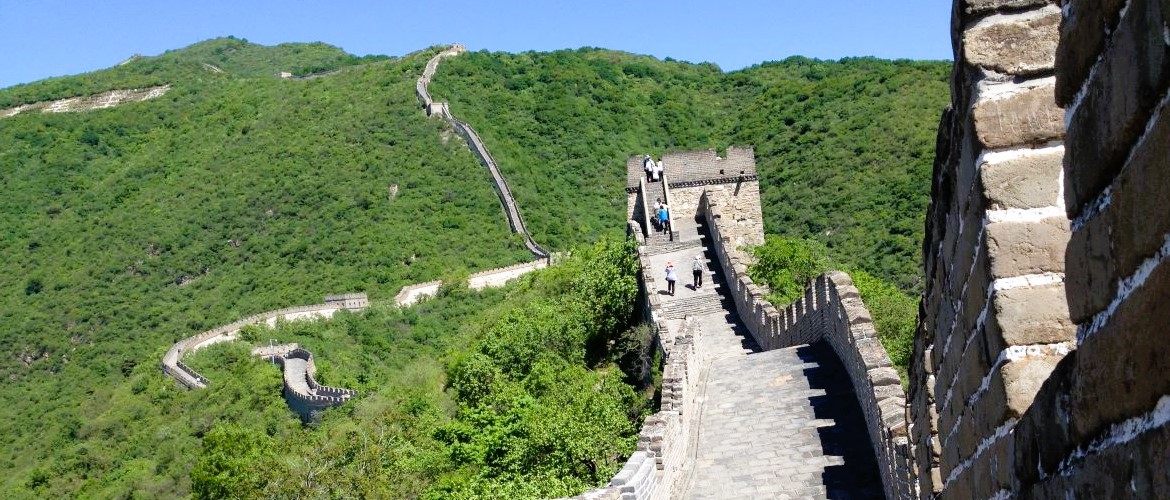
After an early breakfast we embark on a full-day excursion to the legendary Great Wall at Mutianyu, 75 km northeast of the city.
Zigzagging over 6,000 kilometres from east to west along the undulating mountains, the Great Wall was built to hold off tribal invaders from the north. As history shows, the Wall failed the Chinese rulers miserably, especially in the case of Kublai Khan whose men swept across China from the Mongolian steppe, thus marking the beginning of the Yuan Dynasty (1279-1368).
Construction of the earliest sections of the Wall started in the 7th century BCE. A major renovation started with the founding of the Ming Dynasty in 1368 and took 200 years to complete. The wall we see today in Beijing is almost exactly the result of this effort.
Day 10: Beijing – Xi’an (B/L/D)
We begin our sightseeing today with a visit to a traditional hutong neighbourhood. Hutong refers to an ancient alleyway with siheyuan or “4-sided courtyard house” on both sides. The name hutong dates back to the Yuan Dynasty (1279 – 1368 CE). According to some experts, the word originated from the Mongolian language, in which it is pronounced as “hottog” and means “well”. In ancient times, people tended to gather and live around wells. Therefore, the original meaning of hutong should be “a place where people live around”.
Next on our schedule is the Summer Palace, a well-preserved UNESCO World Cultural Heritage Site. The imperial resort was first named Garden of Clear Ripples, which was burnt down by the allied forces of Great Britain and France in 1860 at the end of the Second Opium War (referred to as Arrow War by the British). Reconstruction started 25 years later and was completed in 1895 when the name was changed to Yi He Yuan (Garden of Good Health and Harmony). The design gives prominence to Longevity Hill, as well as Kunming Lake south of the hill. The sprawling complex covers an area of 290 hectares and the buildings inside consist of over 3,000 bays.
We travel to Xi’an by high-speed train (#G87, 14:00/18:23). The 4-hour-23-minute rail journey through fertile farmland dotted with villages provides the visitor with an excellent way to enjoy the beautiful countryside. The track you travel on between Beijing and Zhengzhou is part of the 2,298 km high-speed railway linking Beijing and subtropical Guangzhou and is also the longest high-speed rail line in the world. In the past 20 years China has been on a building spree expanding the country’s rail network and upgrading existing railways. Its high-speed rail service rivals France’s TGV and Japan’s shinkansen in safety, speed, comfort and punctuality.
Day 11: Xi’an (B/L)
With a history going back over 3,000 years, Xi’an served as China’s capital of several ruling dynasties including the Han (206 BCE – 220 CE) and the Tang (618 – 907). It is home to the famous Terracotta Army and the eastern terminus of the ancient Silk Road – a network of trade routes connecting China proper with regions as far as the Mediterranean beginning in the Second Century BCE.
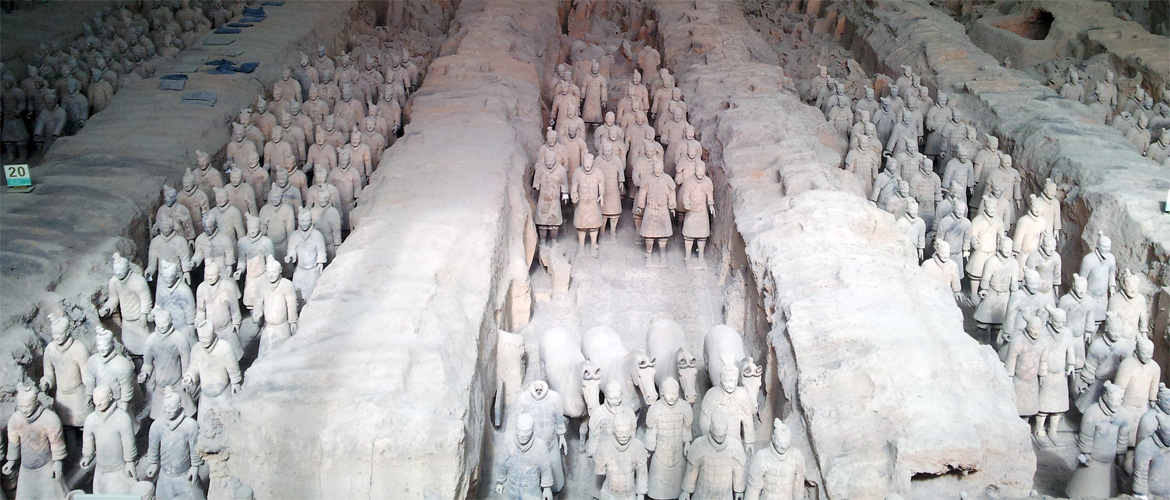
We spend the morning visiting the Terracotta Army Museum located 30 km east of the city. Designed to follow the first emperor of the Qin Dynasty (221-206 BCE) into eternity, the Terracotta Army represents one of the greatest archeological discoveries of the 20th century.
After lunch we return to the city for a stroll on the ancient city wall. Declared a national treasure by the State Council in 1961, the wall (first built in 1370) encircles an area of 14 square kilometres. It runs 13.7 kilometres long and measures 12 metres in height with a thickness at the base between 15 and 18 metres.
Day 12: Xi’an – Shanghai (B/L)
Morning sightseeing begins at Shaanxi Provincial Museum. The modern, well-organized museum was completed in 1992 and traces the history of Xi’an from prehistory to the Qing dynasty (1644-1912). The extensive galleries and exhibitions offer the visitor an excellent introduction to the area that greatly improves understanding of the numerous historical sites in and around the city.
We then visit the grand mosque in the old town centre and the adjacent Muslim bazaar. The mosque was established in the 8th century but the majority of the complex was constructed in the Ming Dynasty (1368-1644). It was further expanded in the Qing Dynasty (1644-1912). Unlike mosques elsewhere, this one is completely Chinese in style. It has neither domes nor traditional minarets.
This afternoon we ride the bullet train (G1934, 15:32/21:23) to Shanghai. Dinner is not provided today. Reasonably priced hot food and all kinds of beverages including alcohol are available for purchase on the train.
Day 13: Shanghai (B/L/D)
With a population close to 25 million, Shanghai is China’s largest city and a dynamic hub of global trade and cultural exchange. The city delights visitors from around the world with its futuristic skyline and historical landmarks.
We begin our day with a visit to Jade Buddha Temple located in an old neighbourhood. We then walk the famous Bund – a waterfront promenade with a riveting history.
After lunch, we stroll the historical People’s Park and adjacent People’s Square in the heart of the city. Originally part of the Shanghai Race Club first established in 1850, the park and the square are surrounded by world-class museums and shops, which attract millions of visitors each year.
We wrap up the day’s sightseeing with a tour of the exquisite Yu Garden in the old town centre.
Day 14: Shanghai (B)
Free day to explore on your own.
If you are interested in art and history, Shanghai Museum would be a great place to spend half a day. This museum houses a huge collection of precious national treasures. Shanghai Jewish Refugees Museum and Nanwaitan Fabric Market (high-end tailor shops) are also recommended.
Optional Suzhou Day Tour
After breakfast we ride the high-speed train (30-40 minutes) to Suzhou, an ancient city most famous for its gardens, ancient canals and silk industry. In the late 13th century a Venetian named Marco Polo visited Suzhou and was very impressed by what he saw. He vividly described the prosperous silk industry and dubbed Suzhou “Venice of the East” due to the small waterways crisscrossing the city.
Our full-day schedule takes in the historic Tiger Hill, Humble Administrator’s Garden, a short canal cruise. We return to Shanghai by train in the afternoon.
The all-inclusive price with lunch starts from US$250 per person and requires a minimum of 2 participants to operate.
Day 15/Sat: Returning Home (B)
Your tour ends this morning. Transfer to the airport any time for return flight. Guests flying back to North America will regain a day upon crossing the International Date Line, thus arriving home the same day as departing from Shanghai.
| City | Nights | Hotel | Category |
| Seoul – 1st stay | 1 | The Plaza Hotel Seoul | Luxury /5 stars |
| Busan | 2 | Lotte Hotel Busan | Luxury /5 stars |
| Seoul – 2nd stay | 2 | The Plaza Hotel Seoul | Luxury /5 stars |
| Beijing | 3 | New Otani Chang Fu Gong | Luxury /5 stars |
| Xi’an | 2 | Sheraton Xi’an North City | Luxury /5 stars |
| Shanghai | 3 | Amara Signature Shanghai | Luxury /5 stars |
Dates & Prices
Prices are per person based on double occupancy.
| Depart | Return | Land Only* CA$/US$ |
Single Supplement CA$/US$ |
| 2025 | |||
| 18-Oct | 01-Nov | $7,400/$5,400 | $2,350/$1,715 |
| 25-Oct | 08-Nov | $7,400/$5,400 | $2,350/$1,715 |
| 11-Nov | 25-Nov** | $7,400/$5,400 | $2,350/$1,715 |
| 2026 |
|||
| 19-May | 02-Jun | $7,400/$5,400 | $2,350/$1,715 |
| 23-May | 06-Jun | $7,400/$5,400 | $2,350/$1,715 |
* Land Only price does not include international airfare. Contact us for a fare quote.
** This departure has a modified itinerary. Please contact us for details.
| Tour price includes: | Tour price does NOT include: |
|
See Terms & Conditions for more information. |
Passport
Your passport needs to have at least one blank visa page and six months validity at the end of the tour.
Visa
If you are a visitor from Canada, the US, the UK, Australia and New Zealand, you do not need a visa to enter South Korea as long as your stay is within 90 days.
You do not need a visa to enter China for this tour as the country adopted a 10-day (240 hours) visa-free transit policy in early 2025. This policy applies to Canadians, Americans and visitors from many other Western countries and we expect it to remain unchanged for 2026.
Vaccination
No vaccination is required to enter South Korea and China.