Those planning private Japan tours are invited to check out Laurus Travel.
Laurus Travel is a strong choice for private Japan tours due to its unrivalled expertise, buying power, focus on cultural immersion, and commitment to personalized service. The company is known for well-organized, small group tours with excellent guides and a deep dive into Japanese culture and history. And now we are ready to put what we have to work for those interested in private Japan tours – couples, families with children, and private parties of any size with unique needs.
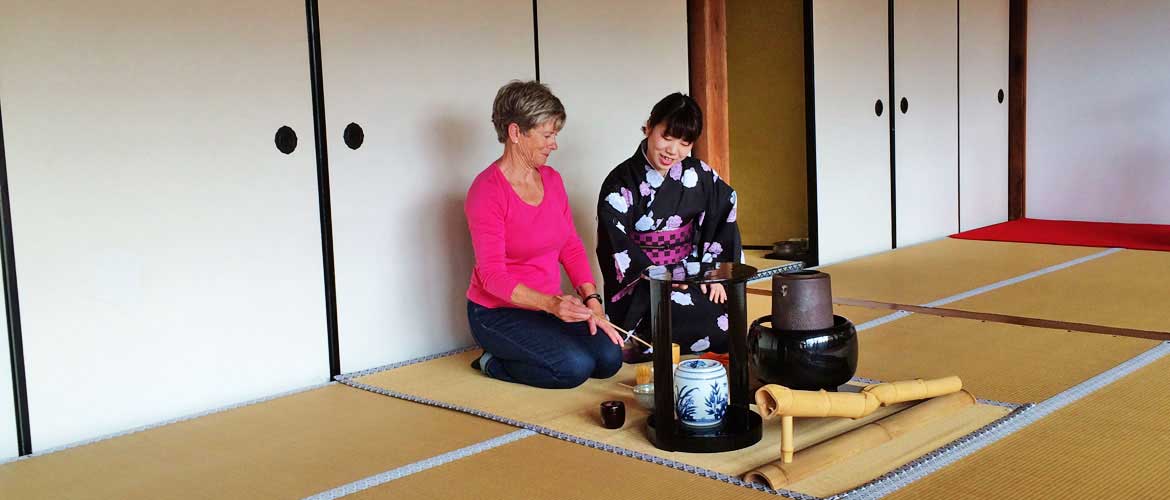
Laurus Travel has a strong reputation among discerning travelers, particularly from Canada, the US, the UK, and Australia, who appreciate high-quality services. The company consistently receives positive feedback from satisfied customers who praise the quality of their guides, the depth of the cultural experience, and the overall organization of their tours.
Our service is not for everyone. Unlike so many other companies, we require a service before doing any work. Please check out our policy before contacting us.
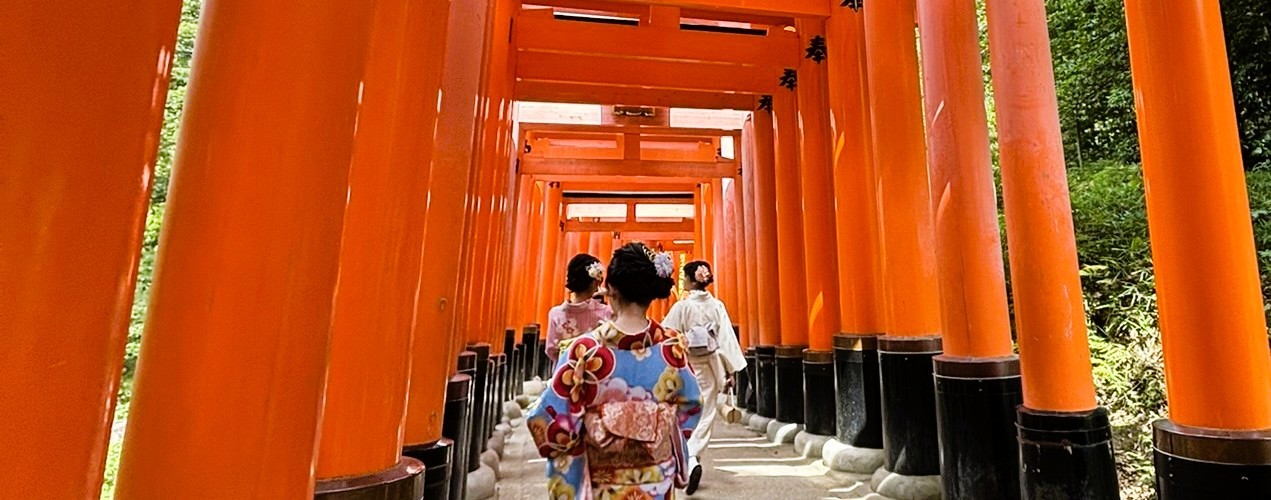
Private Japan Tours – Recommended Itinerary
The 10-day Japan Express Tour below has been popular among couples and families with children looking for a short private Japan tour.
Tokyo – Kyoto – Nara – Osaka
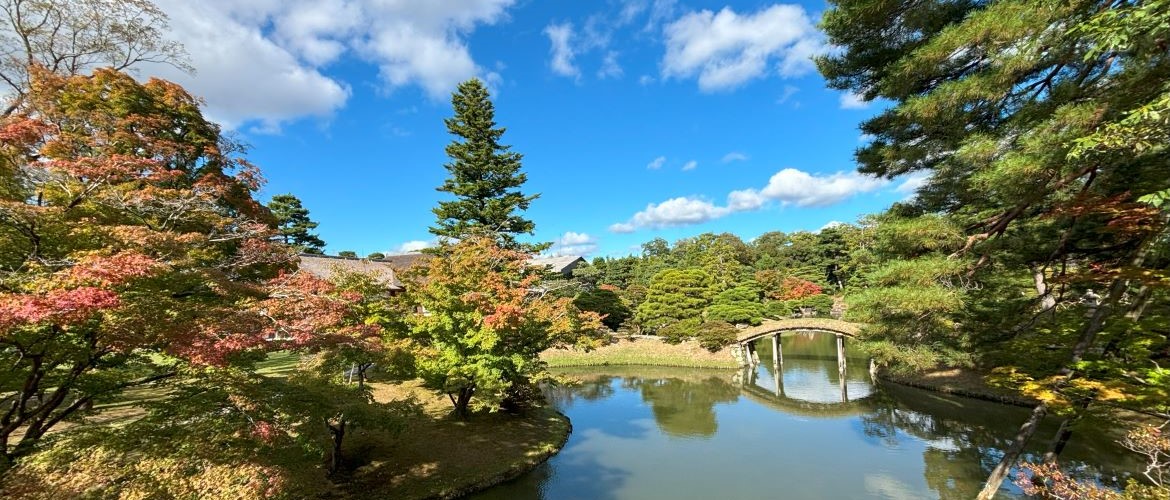
This quick introduction to Japan is intended for the time-pressed looking for a quality Japan experience. The fast-paced premium small-group tour combines Japan’s top three destinations plus Nara, an ancient city that once served as Japan’s capital in the 8th Century.
Guests wishing to extend their stay before or after the guided tour can be accommodated.
Important Features
- Small group size – 20 maximum.
- Experienced professional guides.
- No shopping stops.
- Quality Japanese & Western cuisines.
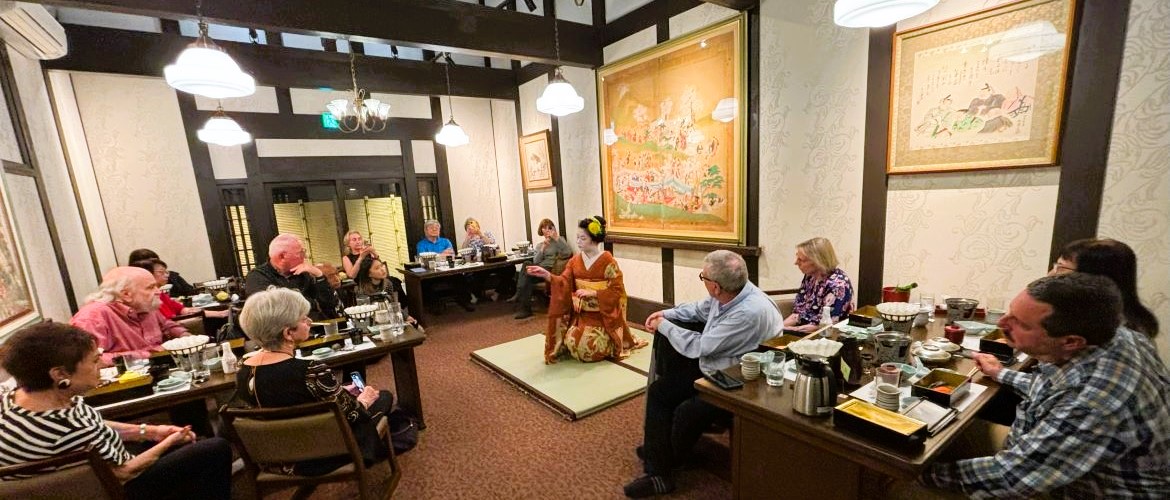
- Kaiseki dinner with dancing geisha (maiko/(舞妓) performance.
Meal Code: B = breakfast / L = lunch / D = dinner
Day 1/Thu: Departing Home City
The journey begins with your transpacific flight departing from a city of your choice. You’ll lose a day upon crossing the International Date Line.
Day 2/Fri: Arrival in Tokyo
Welcome to Tokyo!
Please make your way to the hotel on your own. Detailed up-to-date information on how to get to the hotel will be provided in the pre-trip update two weeks before departure.
Day 3/Sat: Tokyo (B/L)
Tokyo, literally meaning “eastern capital” and officially named Tokyo Metropolis, is one of the most populous mega-cities in the world with a population of 14 million. Formerly known as Edo, the city has been the de facto seat of the Japanese government since 1603 when shogun Tokugawa Ieyasu chose the city for his headquarters. The shogun (general) was a hereditary commander ceremoniously appointed by the emperor but held real power over the country during the shogunate period between 1192 and 1867. Edo was renamed Tokyo after Emperor Meiji moved his seat from Kyoto in 1868 when the last shogun was forced to return power to the imperial court. The city covers an area of 2,187 square kilometres following the merger in 1943 of the city of Tokyo and Tokyo Prefecture.
Our full-day sightseeing begins at the plaza in front of the Imperial Palace. A stroll across the plaza accompanied by commentaries on the imperial family and the history of Tokyo gets the tour off to a good start.
We then proceed to Senso-ji, the oldest Buddhist temple in Tokyo dating back to 628.
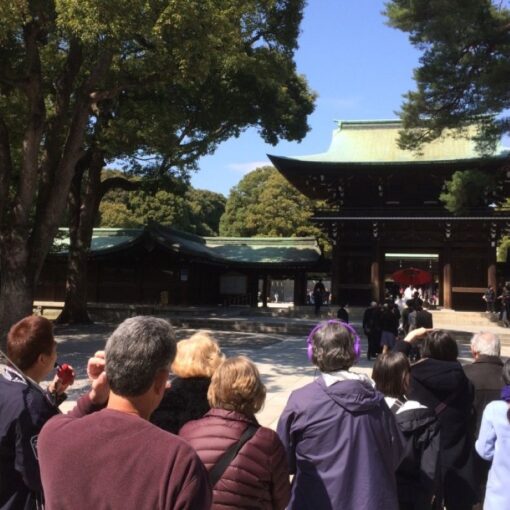
After lunch, we drive through the ritzy Ginza shopping district on the way to Meiji Jingu, a Shinto shrine dedicated to Emperor Meiji (1852 -1912) and his wife.
We end the day with a visit to the observation deck atop the Tokyo Metropolitan Government Building in Shinjuku. On a clear day, the visitor could see the peak of Mount Fuji which is located about 84 km to the west. The building complex completed in 1990 at a cost of US$1 billion consists of three main structures each taking up a city block. The architect of the Tokyo Metropolitan Government Building is Kenzo Tange (1913 – 2005), who in 1987 became the first Japanese to win the Pritzker Prize for Architecture.
Day 4/Sun: Tokyo (B)
Free day to explore on your own.
We recommend Ginza and Akihabara shopping districts, which even non-shoppers would find exciting. Also recommended are the top-rated Tokyo National Museum and The National Museum of Western Art – both located at Ueno Park, one of Tokyo’s most popular locations for cherry blossom every spring.
Day 5/Mon: Tokyo – Kyoto (B/L)
This morning we ride the Shinkansen bullet train (Nozomi #217, 09:21/11:32) to Kyoto.
Nicknamed “City of Ten Thousand Shrines”, Kyoto (literal translation: capital city) served as Japan’s capital for more than one thousand years before the imperial court moved to Tokyo in 1868 with the onset of the Meiji Restoration (1868 to 1912, a historical period associated with the emergence of Japan as a modernized nation). Kyoto is a scaled replica of the Chinese Tang Dynasty’s capital Chang’an, present-day Xi’an. The Tang Dynasty (618 – 907) was a golden era in Chinese history and a time when Japanese adoption of Chinese culture reached its peak. Kyoto today, with a population of 1.5 million, forms a major part of the Kyoto-Osaka-Kobe metropolitan area.
Our first stop after lunch is Kinkaku-ji (Temple of Golden Pavilion). This is a Zen Buddhist temple and one of 17 locations comprising the Historic Monuments of Ancient Kyoto World Heritage Site.
We then proceed to the Arashiyama (Storm Mountain) area where our sightseeing takes in Tenryu-ji Temple and the Bamboo Forest. Located on the western outskirts of Kyoto, Arashiyama is famous for its immense natural beauty as well as its historical and cultural prominence due to the large number of well-preserved ancient Buddhist temples.