
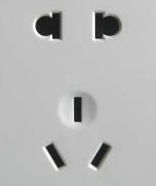
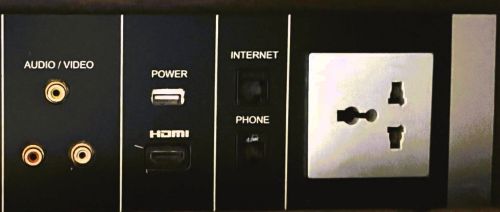
Except in Japan, the standard electrical voltage in all the countries we travel to is 220/240 volts AC, 50Hz. The Japanese standard is 110 volts. There is no need to bring your own adapter plugs or waste time trying to figure out if the power sockets would work for your mobile phone’s charging cable or battery charger. The hotels we use all have proper set-up in each room to allow international guests to charge their devices without hassle. In rare cases when the power sockets couldn’t handle the power plug for your mobile device, you can always borrow an adapter from the front desk.
Your personal electronic devices should be able to handle voltages between 110 and 240 for charging. If not, it would mean your devices are too old.
Electricity and Voltage – Unique Japanese System
Japan is the only country with a nationwide standard of 100V AC, whereas neighboring Asian countries predominantly use 220–240V. This anomaly dates back to the late 19th century, complicated by a split in electrical frequency (Hz).
The 100V Anomaly
During the Meiji era, the initial grid operators for Eastern Japan (Tokyo) purchased 50Hz generators from Germany. Meanwhile, Western Japan (Osaka) imported 60Hz equipment from the United States. Because American grids initially experimented with 100V before settling on 120V, Japan adopted the 100-volt standard.
The East/West Split
Because Japan’s grids were built by two different foreign suppliers, the country remains geographically divided. Eastern Japan (including Tokyo, Yokohama, and Tohoku) operates at 50 Hz, while Western Japan (including Nagoya, Osaka, and Kyoto) operates at 60 Hz.
Why it never changed
Although other countries eventually standardized their power grids, Japan’s early industrial boom made the cost of retrofitting the entire country prohibitive. Today, a series of frequency converter stations allow some power sharing between the regions, but the dual system remains.
For travelers and residents, this means that while Japanese plugs look identical to ungrounded North American plugs, the lower voltage can cause high-wattage, heating-based appliances (like hair dryers) to run slowly or inefficiently. Conversely, bringing foreign appliances into Japan may require a step-up voltage converter.