
Kathmandu – Chitwan – Pokhara – Kathmandu – Thimphu – Punakha – Phobjikha Valley – Paro – Kathmandu – Lhasa – Shigatse – Mt. Everest Base Camp – Tingri – Shigatse – Lhasa
This 26-day Grand Himalayan Adventure brings together three of Asia’s most fascinating destinations: Nepal, Bhutan and Tibet. Beginning in Kathmandu, the journey takes us through Nepal’s ancient cities, the wildlife-rich Chitwan National Park and the scenic landscapes of Pokhara. In Bhutan, we explore historic monasteries, imposing fortresses and peaceful mountain valleys before continuing to Tibet, where the highlights include Lhasa’s magnificent Potala Palace, sacred Buddhist monasteries and an excursion to Everest Base Camp.
Combining extraordinary Himalayan scenery with rich cultural heritage and distinctive local traditions, this premium small-group tour offers an in-depth exploration of one of the world’s most captivating regions.
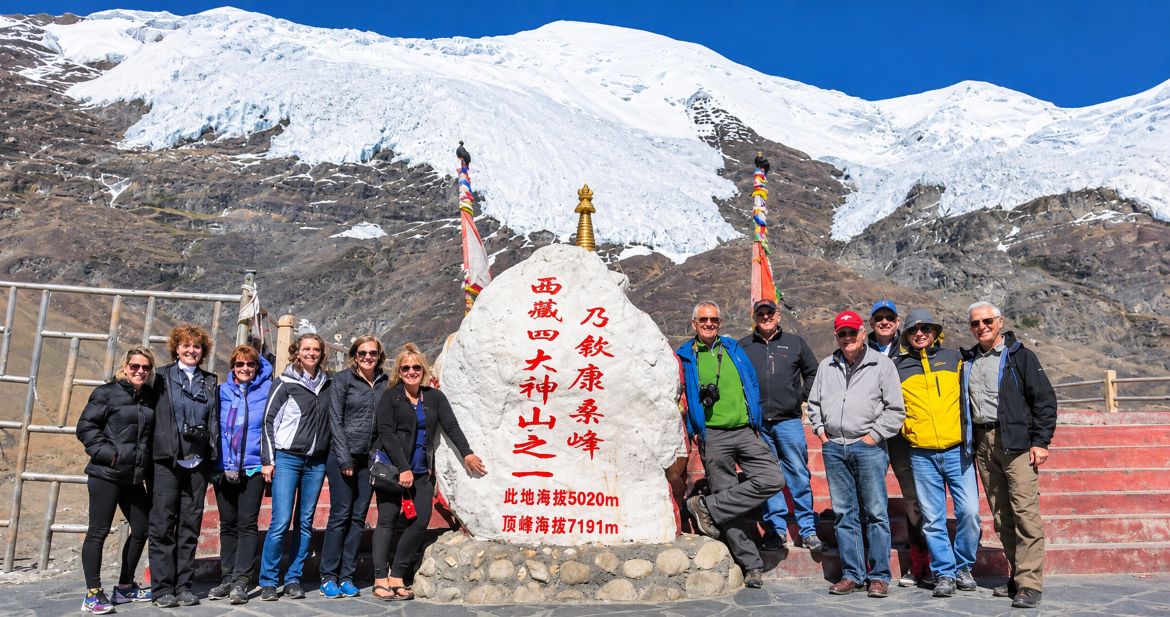
This is a physically demanding endeavour taking you to locations as high as 5,020 metres (16,470 feet) above sea level. Travellers prone to altitude sickness must take precaution.
Important Features
- Expert local guides
- Small group size – maximum 15
- Premium accommodations
- No shopping stops
- Quality meals
- Unlimited supply of bottled water during group activities
- Free Wi-Fi in all hotels
Tour Itinerary
Meal Code: B = Breakfast / L = Lunch / D = Dinner
Day 1: Departing for Nepal
Depart for Nepal from a city of your choice. As there are no direct flights from North America, travellers must connect through an Asian gateway such as New Delhi or a major city in China.
Day 2: Arrival in Kathmandu (D)
Upon arrival at Kathmandu’s Tribhuvan International Airport, meet your guide and transfer to the hotel by private vehicle. The remainder of the day is free to rest or explore at your leisure.
Day 3: Kathmandu (B/L/D)
Kathmandu, Nepal’s capital, lies in a valley at approximately 1,350 metres above sea level. Surrounded by mountains, the city is known for its historic temples, traditional architecture and rich religious heritage.
This morning, we visit Kopan Monastery, a Tibetan Buddhist monastery on a hill overlooking Kathmandu. Founded in the early 1970s, it is an important centre for Buddhist study and meditation.
Next, we explore Boudhanath Stupa, one of Nepal’s most important Buddhist pilgrimage sites and a UNESCO World Heritage Site. Its massive white dome, gilded spire and colourful prayer flags make it one of Kathmandu’s most recognizable landmarks.
After lunch, we visit Patan Durbar Square, renowned for its Newari architecture, temples and royal palace complex.
We conclude our sightseeing at Kathmandu Durbar Square, where we visit Kumari Ghar, the residence of Nepal’s Living Goddess, a young girl selected according to centuries-old religious traditions.
Day 4: Kathmandu (B/L)
After breakfast, we drive to Bhaktapur, approximately 14 km east of Kathmandu. One of the Kathmandu Valley’s three historic royal cities, Bhaktapur is renowned for its well-preserved Newari architecture, temples and traditional crafts.
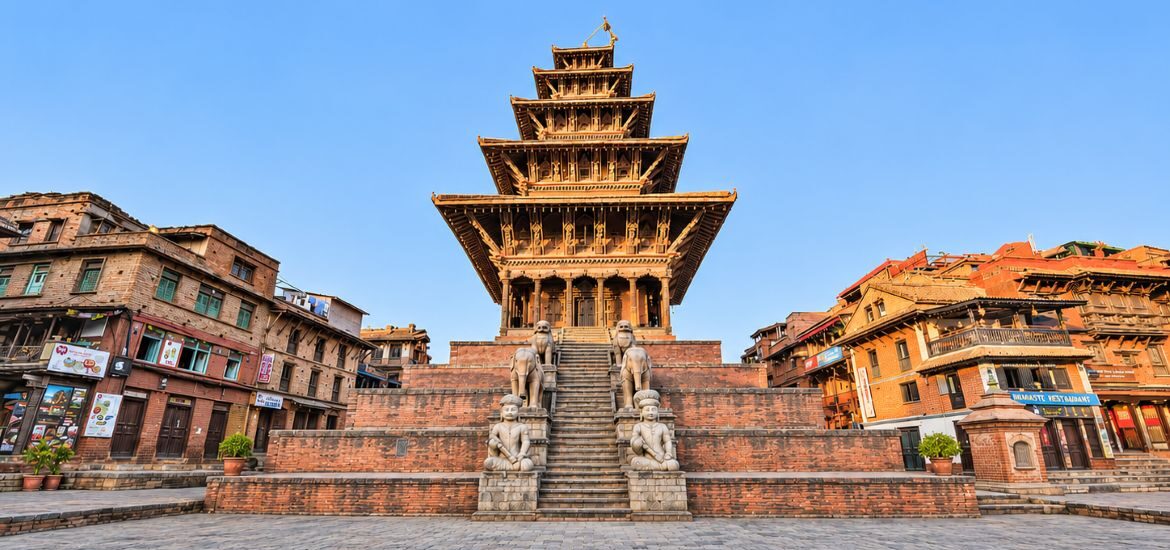
We explore Bhaktapur Durbar Square, a UNESCO World Heritage Site, and visit Taumadhi Square to see the five-storey Nyatapola Temple, Nepal’s tallest pagoda-style temple. We also have an opportunity to observe local artisans at work and try our hand at traditional pottery making.
Return to Kathmandu in the afternoon.
Day 5: Kathmandu – Chitwan (B/L/D)
This morning, we drive through the winding gorges and across fast-flowing rivers to Chitwan National Park, a UNESCO World Heritage Site in southern Nepal.
Covering approximately 932 square kilometres, the park protects a rich variety of wildlife, including greater one-horned rhinoceroses, Bengal tigers, wild elephants, crocodiles and numerous bird species. While rhinoceros sightings are relatively common, tigers are rarely seen.
After lunch at the jungle lodge, we visit a nearby Tharu village to learn about the traditions and daily life of this indigenous community. In the evening, enjoy a performance of traditional Tharu dances.
Day 6: Chitwan (B/L)
Today is devoted to exploring Chitwan National Park. Activities include an early morning jeep safari, canoeing and birdwatching. Keep an eye out for rhinoceroses, crocodiles, deer and a wide variety of birds.
The afternoon offers further opportunities to explore the park and observe its wildlife in their natural habitat.
Day 7: Chitwan – Pokhara (B/L)
After breakfast, we drive to Pokhara, Nepal’s third-largest city and a major gateway to trekking in the Annapurna region. Situated at approximately 822 metres above sea level, Pokhara is known for its beautiful lakes and spectacular Himalayan scenery. On clear days, the Annapurna range and the distinctive peak of Machhapuchhre (Fishtail Mountain) dominate the skyline.
Later in the evening, enjoy a boat ride on Phewa Lake, followed by a visit to Tal Barahi Temple, located on an island in the middle of the lake.
Day 8: Pokhara (B/L)
We begin the day with an early morning excursion to Sarangkot, a popular viewpoint offering spectacular views of the Annapurna range, including Machhapuchhre (Fishtail Mountain), weather permitting.
After enjoying the mountain scenery, we walk back through farmland and forest before returning to the hotel for breakfast.
Later, take part in a cooking class to learn how to make momos, traditional Nepalese dumplings.
The afternoon is free for relaxation or independent exploration.
Day 9: Pokhara – Kathmandu (B/L/D)
After breakfast, we drive back to Kathmandu and transfer to our hotel.
Later, we visit Swayambhunath, also known as the Monkey Temple. Perched on a hill overlooking Kathmandu Valley, this ancient Buddhist complex is famous for its white-domed stupa, gilded spire and panoramic views. It forms part of the Kathmandu Valley UNESCO World Heritage Site.
Next, we visit Pashupatinath Temple, one of Hinduism’s most sacred shrines dedicated to Lord Shiva. Situated on the banks of the Bagmati River, the temple complex is an important pilgrimage site where traditional religious ceremonies, including cremation rituals, take place.
Following dinner, we meet a Sherpa mountaineer who shares his experiences and stories of climbing Mount Everest.
Day 10: Kathmandu (B)
Today is free for shopping, relaxation or independent exploration of Kathmandu.
Day 11: Kathmandu – Thimphu (B/L/D)
After breakfast, we fly to Paro, Bhutan’s international gateway. Upon arrival, meet our local guide and drive to Thimphu, the capital of Bhutan.
We begin our sightseeing at the National Memorial Chorten, built in 1974 in honour of Bhutan’s third king, Jigme Dorji Wangchuck. This prominent Buddhist monument is an important place of worship, where local devotees gather to pray and circumambulate the chorten.
Day 12: Thimphu (B/L/D)
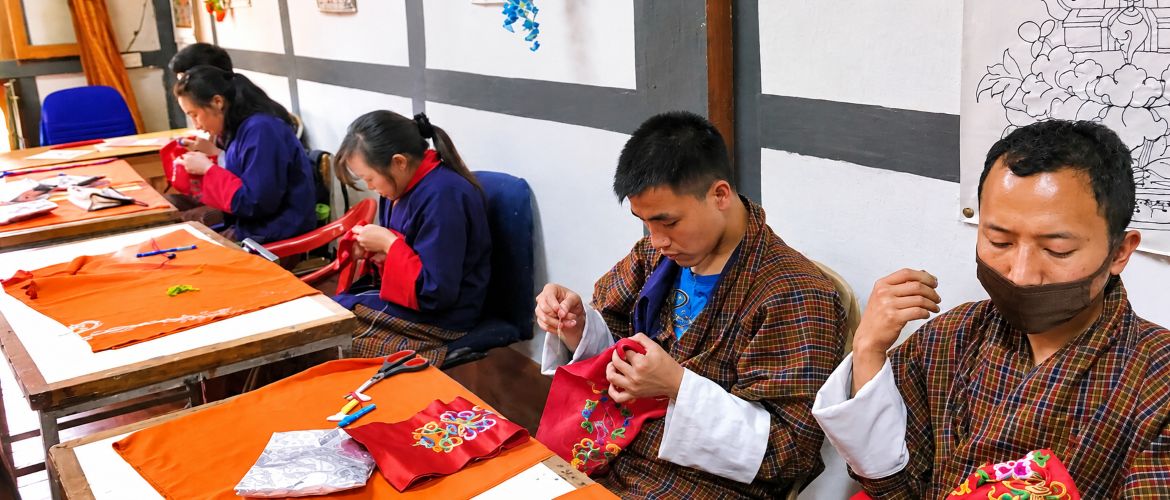
We begin the day at a local market, followed by a visit to the National Institute for Zorig Chusum, commonly known as the School of Arts and Crafts, where students learn Bhutan’s 13 traditional arts.
In the afternoon, we visit the National Library and Bhutan Post Office, where you can order personalized postage stamps featuring your own photograph.
Day 13: Thimphu – Punakha (B/L/D)
After breakfast, we drive to Punakha, Bhutan’s former capital, crossing Dochula Pass (3,100 metres), where clear weather offers panoramic views of the snow-capped Himalayas.
Before reaching our hotel, we take a scenic walk through rice fields to Chimi Lhakhang, a temple dedicated to the Divine Madman, Drukpa Kunley, and traditionally associated with fertility blessings.
Day 14: Punakha (B/L/D)
We begin the day with a visit to Punakha Dzong, one of Bhutan’s most impressive fortresses. Built in 1637 at the confluence of the Pho Chhu and Mo Chhu rivers, it is renowned for its traditional Bhutanese architecture and historical significance.
Afterwards, we enjoy a scenic hike to viewpoints overlooking the dzong and the surrounding valley.
Day 15: Punakha – Phobjikha Valley (B/L/D)
After breakfast, we drive approximately two hours to Phobjikha Valley, a beautiful glacial valley known for its wintering population of vulnerable black-necked cranes.
After lunch at a local farmhouse, we enjoy a scenic 2½-hour hike through the valley to Gangtey Monastery, one of Bhutan’s most important Buddhist monasteries. In the evening, we attend a monk-led meditation session, subject to availability.
Day 16: Phobjikha Valley – Paro (B/L/D)
Enjoy a leisurely morning in Phobjikha Valley, with free time to explore the peaceful surroundings.
After lunch, we depart for Paro, retracing our route through Bhutan’s mountainous countryside. The scenic drive takes approximately five hours.
Day 17: Paro (B/L/D)
This morning, we hike to Paro Taktsang, better known as Tiger’s Nest Monastery, Bhutan’s most famous landmark. Perched dramatically on a cliff approximately 900 metres above Paro Valley, the monastery is one of the country’s most sacred Buddhist sites. The round-trip hike takes approximately 4–6 hours.
In the afternoon, we visit the National Museum of Bhutan, housed in a historic watchtower overlooking Paro Valley, followed by Rinpung Dzong, an impressive fortress and monastery that also serves as the district’s administrative centre.
Day 18: Paro – Kathmandu (B)
Fly to Kathmandu in the morning and have the balance of the day at leisure upon arrival. Airport transfers at both ends are included.
Day 19: Kathmandu – Lhasa (B/D)
We board a morning flight (1 hour 30 minutes) for Lhasa and spend the remainder of the day relaxing to acclimatize to the high altitude.
Situated in a wide, mountain-fringed valley on the north bank of the Kyichu River, Lhasa (elevation 3,650 m) is a rapidly expanding city with a population around 870,000 as of late 2022.
Lhasa’s rise to prominence began in the seventh century, when King Songtsen Gampo established his capital here and encouraged the development of Buddhism. Originally known as Rasa, the settlement gradually became known as Lhasa, meaning “Place of the Gods”. Following the decline of the Tibetan Empire in the ninth century, the city’s political importance diminished. Lhasa regained its position as Tibet’s centre of government in the 17th century under the Fifth Dalai Lama.
Day 20: Lhasa (B/L)
This morning we visit Norbulingka, whose name means “Jewelled Park”. First built in 1755, Norbulingka covers an area of 89 acres and served as the traditional summer residence of the successive Dalai Lamas. A short distance to the southwest of the Potala Palace, Norbulingka forms part of a UNESCO World Heritage Site collectively known as the Historic Ensemble of the Potala Palace.
This afternoon we tour the grand Sera Monastery, where lively debates held every day except Sunday between resident monks often draw a large audience. Sera Monastery is recognized as one of the “great three” Gelug university monasteries of Tibet together with Ganden Monastery and Drepung Monastery.
Day 21: Lhasa (B/L)
This morning we visit the Potala Palace. This was the chief residence of the Dalai Lama until the 14th Dalai Lama fled to India during the 1959 Tibetan uprising. Now a museum, the palace is named after Mount Potalaka, the mythical abode of the bodhisattva Avalokitesvara. The 5th Dalai Lama started its construction in 1645 after one of his spiritual advisers pointed out that the site was ideal as a seat of government, situated as it is between Drepung and Sera monasteries and the old city of Lhasa. The palace sits on the site of an earlier fortress built by King Songtsen Gampo. The main building measures 360 metres east-west and 140 metres north-south. Thickness of the exterior granite walls varies between 2 and 5 metres.
Afternoon sightseeing takes place at Jokhang Temple, one of the oldest Buddhist buildings in Tibet and a remarkable combination of Tibetan, Indian, Nepalese and Han Chinese architectural styles. No visit to Jokhang Temple is complete without exploring Barkhor Street and its lively market.
Day 22: Lhasa – Gyantse – Shigatse (B/L/D)
Following breakfast, we drive along the Southern Route to Gyantse (265 km).
Highlights of the scenic drive include Kamba La Pass (4,700 metres above sea level) and the sacred Yamdrok Lake. Every summer, throngs of Tibetan pilgrims come to the lake to pray for blessings by the lake goddess.
Afternoon sightseeing in Gyantse takes in the Fortress of Gyantse Dzong and Pelkor Chode. We continue to Shigatse (90 km), arriving around dinnertime.
Day 23: Shigatse – Everest Base Camp – Tingri (B/L/D)
Today we travel across the Tibetan Plateau to the Everest region, one of the most spectacular destinations in Tibet. Our journey takes us to Rongbuk Monastery, situated at approximately 5,000 metres above sea level. The monastery is renowned for its extraordinary views of Mount Everest and its dramatic setting beneath the world’s highest mountain.
We continue to the designated Everest Base Camp visitor area (approximately 5,150 metres), where, weather permitting, we enjoy magnificent views of Everest’s north face.
After our visit, we return to Tingri for the night.
Day 24: Tingri – Shigatse (B/L/D)
After breakfast, we return to Shigatse, travelling across the vast Tibetan Plateau with views of the surrounding Himalayan landscape.
This evening, enjoy a Tibetan dinner accompanied by traditional music and dance performances.
Day 25: Shigatse – Lhasa (B/L/D)
This morning we visit Tashilhunpo Monastery, the traditional seat of the Panchen Lama and one of Tibet’s most important Buddhist monasteries. Founded in 1447, the monastery is renowned for its impressive architecture, religious treasures and enormous gilded statue of Maitreya Buddha.
After lunch we drive back to Lhasa via a different route – the better paved Northern Route (295 km). Vast pastureland, barren mountain slopes, snow-capped peaks, blue skies, white clouds, the scant population, and ubiquitous prayer flags – these images combine to conjure a sense of solitude and mystery.
Day 26: Lhasa – Home City (B)
The tour ends this morning.
To fly home, you might need to fly to Beijing or Shanghai or Guangzhou first. Extension to any Chinese city including air, hotel and airport transfer reservations can be arranged on request.
Hotel List
| City/Location | Nights | Hotel | Category |
| Kathmandu – 1st stay | 3 | Radisson Hotel Kathmandu | Luxury |
| Chitwan | 2 | Kasara Resort | Luxury |
| Pokhara | 2 | Fishtail Lodge | Luxury |
| Kathmandu – 2nd stay | 2 | Radisson Hotel Kathmandu | Luxury |
| Thimphu | 2 | Terma Linca Resort & Spa | Luxury |
| Punakha | 2 | Dhensa Boutique Resort | Luxury |
| Gangtey | 1 | Gangtey Lodge | Luxury |
| Paro | 2 | Le Méridien Paro, Riverfront | Luxury |
| Kathmandu – 3rd stay | 1 | Radisson Hotel Kathmandu | Luxury |
| Lhasa – 1st stay | 3 | InterContinental Lhasa | Luxury |
| Shigatse – 1st stay | 1 | Hilton Shigatse | Luxury |
| Tingri | 1 | Pingcuo Kangsang Hotel | 4-star/best available |
| Shigatse – 2nd stay | 1 | Hilton Shigatse | Luxury |
| Lhasa – 2nd stay | 1 | InterContinental Lhasa | Luxury |
Dates & Prices
Prices are per person based on double occupancy. International air is extra.
| Depart (Wed) | Return (Sun) | Land Only CA$/US$ | Single Supplement CA$/US$ |
| 2027 | |||
| 03-Mar | 28-Mar | $18,710/$13,560 | $5,510/$3,995 |
| 10-Mar | 04-Apr | $18,710/$13,560 | $5,510/$3,995 |
| 17-Mar | 11-Apr | $18,710/$13,560 | $5,510/$3,995 |
| 24-Mar | 18-Apr | $18,710/$13,560 | $5,510/$3,995 |
| 31-Mar | 25-Apr | $18,710/$13,560 | $5,510/$3,995 |
| 07-Apr | 02-May | $18,710/$13,560 | $5,510/$3,995 |
| 14-Apr | 09-May | $18,710/$13,560 | $5,510/$3,995 |
| 21-Apr | 16-May | $18,710/$13,560 | $5,510/$3,995 |
| 28-Apr | 23-May | $18,710/$13,560 | $5,510/$3,995 |
| 05-May | 30-May | $18,710/$13,560 | $5,510/$3,995 |
| 12-May | 06-Jun | $18,710/$13,560 | $5,510/$3,995 |
| 06-Oct | 31-Oct | $18,710/$13,560 | $5,510/$3,995 |
| 13-Oct | 07-Nov | $18,710/$13,560 | $5,510/$3,995 |
| 20-Oct | 14-Nov | $18,710/$13,560 | $5,510/$3,995 |
| 27-Oct | 21-Nov | $18,710/$13,560 | $5,510/$3,995 |
| 03-Nov | 28-Nov | $18,710/$13,560 | $5,510/$3,995 |
What the tour price includes:
| What the tour price excludes:
See Terms & Conditions for more information. |
Know Before You Go
When is the best time to visit Nepal, Bhutan and Tibet?
Spring (March to May) and autumn (October to November) are generally the best seasons for this tour. Spring brings pleasant temperatures and flowering rhododendrons, while autumn offers clearer skies and excellent mountain views.
October and November are particularly favourable for sightseeing and photography, although temperatures at higher elevations in Tibet can be very cold, especially around Everest Base Camp.
What are the passport requirements?
Your passport should be valid for at least six months beyond your departure from Nepal, Bhutan and Tibet. We recommend having at least two blank visa pages. Travellers should also check the requirements of any countries they transit through.
Do I need a visa for Nepal?
Canadian and American passport holders require a tourist visa, which can be obtained upon arrival at Kathmandu’s Tribhuvan International Airport.
Visa fees are US$30 for 15 days, US$50 for 30 days and US$125 for 90 days. Travellers are encouraged to complete the online visa-on-arrival form before departure.
For details, visit the Nepal Department of Immigration.
Do I need a visa for Bhutan?
Canadian and American passport holders must obtain a visa before arrival. Laurus Travel will assist with the application process.
Bhutan charges a non-refundable visa application fee of US$40 and a Sustainable Development Fee of US$100 per adult per night. Please refer to your quotation for details of what is included.
For details, visit Bhutan’s official tourism website.
Do I need a visa for Tibet?
Tibet is part of China, so Chinese entry requirements apply. Whether a Chinese visa is required depends on your nationality and the visa policies in effect at the time of travel.
A separate Tibet Travel Permit is required. Laurus Travel will arrange this permit, and its cost is included in the tour price.
What vaccinations are recommended?
Consult a travel health professional at least six weeks before departure. Routine vaccinations should be up to date, and hepatitis A and typhoid vaccinations are commonly recommended for travel to the region. Other vaccinations, including hepatitis B, rabies and Japanese encephalitis, may be advisable depending on individual circumstances.
Yellow fever vaccination certificates are generally required only for travellers arriving from certain countries with a risk of yellow fever transmission.
For current advice, consult Travel.gc.ca or the CDC.
Is altitude sickness a concern?
Yes. The Tibet portion of the tour includes Lhasa at approximately 3,650 metres and excursions reaching over 5,000 metres near Everest Base Camp. Some locations in Bhutan also exceed 3,000 metres.
The itinerary allows time for acclimatization in Lhasa before travelling to higher elevations. Nevertheless, altitude sickness can affect anyone regardless of age or physical fitness. Consult your doctor before departure, stay hydrated, avoid strenuous activity during initial acclimatization and report symptoms promptly to your guide.
Is malaria a concern?
Malaria risk is generally low along this itinerary. The main consideration is Nepal’s southern lowlands, including the Chitwan region. Preventive medication is not routinely recommended for most travellers following this route, but individual medical advice is advisable.
Use insect repellent and take precautions against mosquito bites, particularly in Nepal.
Is tap water safe to drink?
Avoid drinking untreated tap water in all three destinations. Drink bottled, boiled or properly purified water, and avoid ice of uncertain origin. Choose freshly prepared, thoroughly cooked food, and exercise caution with raw vegetables and unpeeled fruit.
How physically demanding is the tour?
This is an active cultural tour involving walking, stairs, uneven terrain and some hiking. The hike to Tiger’s Nest Monastery in Bhutan is particularly demanding, with a substantial uphill climb.
The Tibet portion involves high elevations, including Everest Base Camp. Travellers should be in good physical condition and comfortable with the itinerary’s walking requirements.
What medications should I bring?
Bring sufficient prescription medications for the entire trip, preferably with a small reserve for unexpected delays. Keep medications in their original labelled containers and carry them in your hand luggage, together with copies of your prescriptions.
Consult your doctor about altitude sickness prevention and any medications that may be appropriate. A small personal first-aid kit and hand sanitizer are also recommended.
What currencies are used?
Nepal uses the Nepalese rupee (NPR), Bhutan the Bhutanese ngultrum (BTN), and Tibet the Chinese yuan (CNY).
Credit cards are accepted at many higher-end hotels and establishments, but cash is useful for smaller purchases. ATMs are available in major towns, although access and reliability vary. In Tibet, mobile payments are widely used, but visitors should carry some Chinese cash as a backup.
We recommend obtaining local currency after arrival rather than purchasing it before departure.
Do I need travel insurance?
Comprehensive travel insurance is mandatory. Your policy should cover emergency medical treatment, hospitalization, medical evacuation, trip cancellation and interruption.
Ensure that your coverage includes travel to high elevations, including Everest Base Camp, and any hiking activities included in the itinerary.
