Luxury China tours by train – that’s what Laurus Travel has been offering for many years. If you are indeed looking for luxury China tours by train, you’ve just found the right China tour company in Laurus Travel.
Traveling in China by train offers several advantages for tourists, making it a popular and practical choice. China boasts an extensive and well-developed high-speed rail network that connects major cities across the country. This makes it convenient for tourists to explore different regions efficiently and comfortably.
Train stations are often located in or near city centers, saving tourists the time and hassle of traveling to and from airports. The check-in process for trains is quicker and less cumbersome than that of airports, contributing to a smoother travel experience.
While train travel may not be the fastest option for every journey within China, it offers a range of benefits that make it an attractive choice for many tourists. The combination of speed, comfort, affordability, and the opportunity for cultural immersion makes train travel a compelling option for exploring this vast and diverse country.
Some train routes in China pass through beautiful landscapes, offering tourists a scenic journey, something air travel doesn’t offer. This can enhance the overall travel experience.
Train travel is generally more environmentally friendly compared to air travel. High-speed trains are designed to be energy-efficient, and choosing trains over planes can contribute to a reduction in carbon emissions.
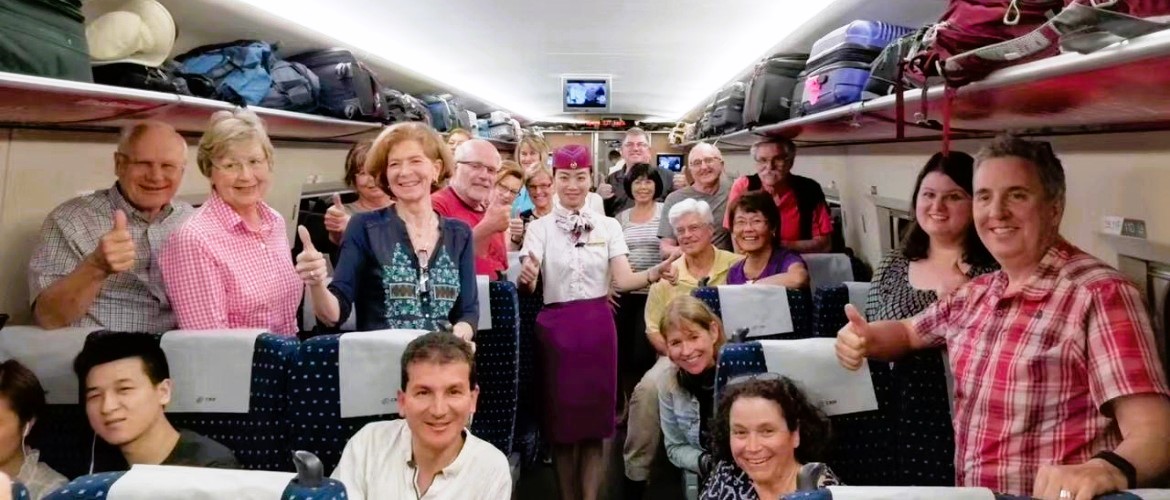
At Laurus Travel. we realized early on that the rapid expansion of China’s high speed rail network would have a very positive effect on our business. With this in mind, we introduced our first China tour exclusively by train in late 2012 and it became an instant hit. Customer Jim R, a retired American Airlines B777 pilot, his wife Cheryl and their friends were among the first to go on this 21-day tour and they just loved it.
—–Original Message—–
From: Cheryl & Jim R
Sent: Thursday, June 13, 2013 6:30 AM
Subject: 21-Day China by First Class Train, Departing May 19, 2013
Amazing trip! First class accommodations; wonderful meals, fun & educational tours; this trip is a WINNER. Traveling by train was so comfortable and an efficent use of time, it was a great way to see & feel the culture of this complex country. Truly a great experience. We have and will continue to recommend Laurus Travel to friends and anyone considering a trip to China. When we return (there is so much to see), Laurus Travel will be our only choice. Truly a trip of a lifetime! Just wish Laurus did other countries!
Cheryl & Jim R
Dallas, Texas
Rapid expansion of China’s high-speed rail network since then has allowed us to transform the 21-day train tour into the current 25-day Classic China by Bullet Train.
Development of China’s Railway System in the Past 30 Years
Thirty-five years ago (1988), the acclaimed travel writer Paul Theroux spent a year travelling around China by train. He wrote a book about his experience and the book became an instant bestseller. Titled Riding the Iron Rooster, the book ends with a chapter named “The Train to Tibet”. Theroux predicted in the book that it would be impossible for the Chinese to build a railway to Tibet due to insurmountable climatic and geological challenges including permafrost. Eighteen years later (2006), the Chinese achieved what he thought to be impossible.
Not only that, the Chinese for the past 20 years have been on a building spree expanding the country’s rail network and upgrading existing railways. The world’s longest high-speed rail line opened in China on December 25, 2012, running 2,298 kilometres (1,428 miles) between Beijing and Guangzhou. The total length of China’s high speed rail network has reached 42,000 kilometres by the end of 2022, which makes up more than two thirds of the world’s total. China is also the only country in the world that has, in full commercial operation, high-speed trains that travel at 350km/h.
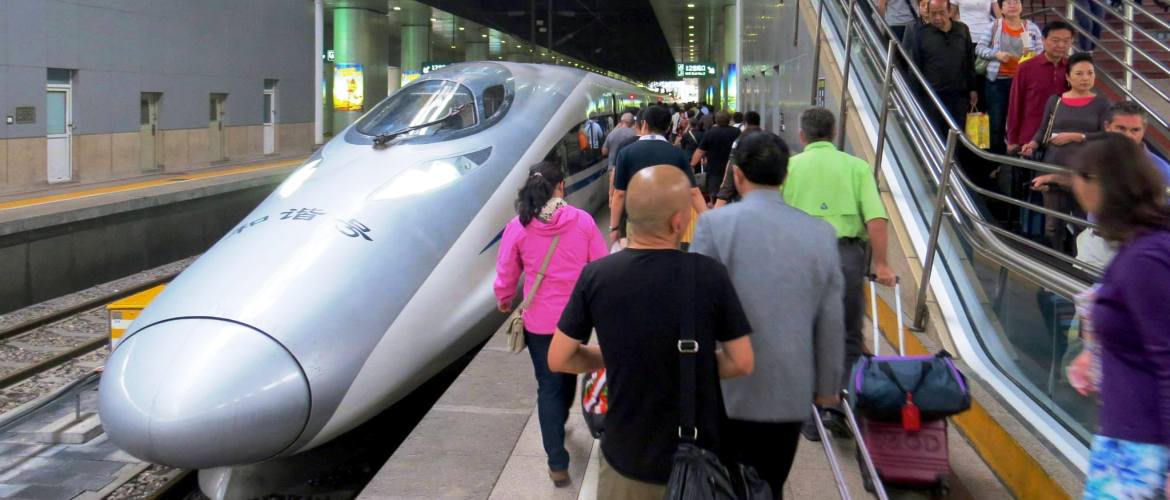
The new developments make it possible for tour operators like Laurus Travel to design new tours incorporating inter-city travel by train. We no longer have to worry about smelly bathrooms and other discomforts associated with train travel of the old days. The passengers won’t have to drag their suitcase up and down long flights of stairs as the train stations on the high-speed rail network all sport efficient escalators and elevators commonly found at major international airports.
Letters G and D
Chinese high speed trains numbered with letter G in the front (G111, for example) travel at an average speed of 300km per hour while train numbers starting with letter D indicate the speed would be between 200km and 250km per hour.
Beijing/Shanghai Line (1318 km)
On June 30, 2011, China opened this much anticipated high speed rail line. Built with the latest technologies from around the world, the 1318km rail line links China’s capital with the country’s largest metropolis. Trains on this new line ferry passengers from one end to the other in less than 5 hours. The new rail service rivals France’s TGV and Japan’s “shinkansen in terms of safety, speed, comfort and punctuality.
Beijing/Guangzhou Line (2298 km)
Good news for Chinese rail travellers just keeps coming. On December 26, 2012, China officially launched its bullet train service on its recently completed high-speed railway connecting Beijing and Guangzhou. At 2,298 km, this is the longest high-speed rail line in the world cutting travel time by train between Guangzhou and Beijing to less then 8 hours, 12.5 hours less than the fastest passenger train running on the old track, which is now used almost exclusively for freight.
Seat Class
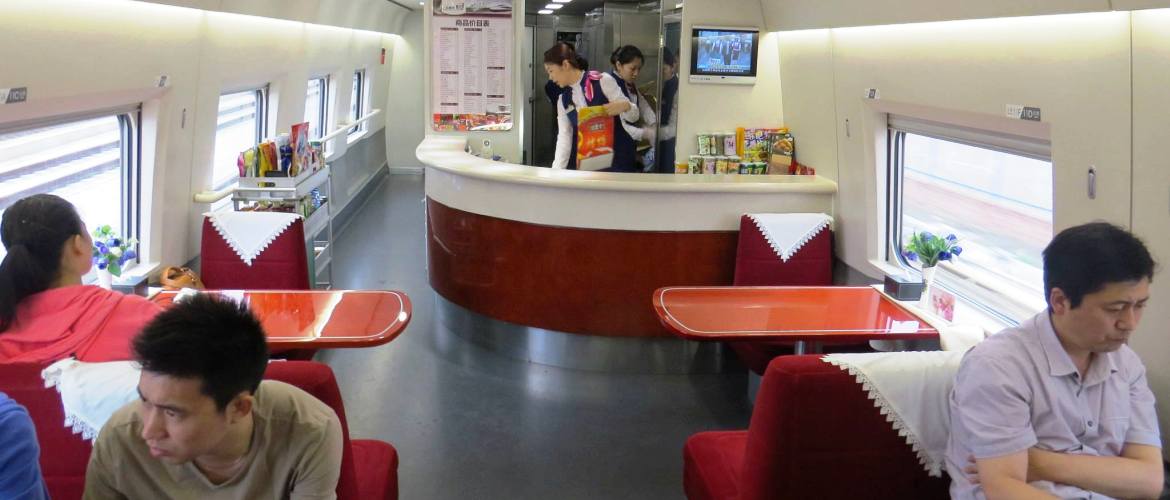
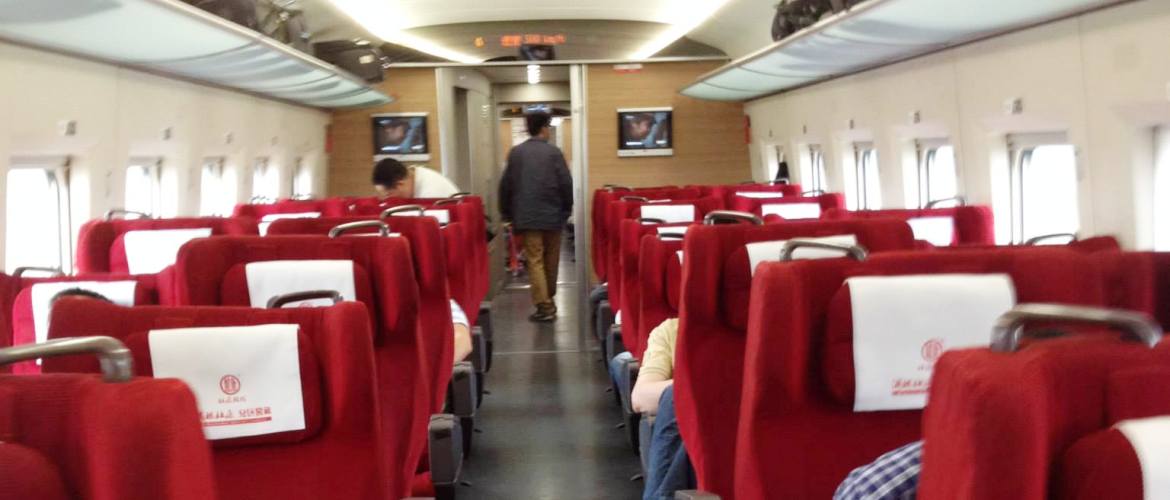
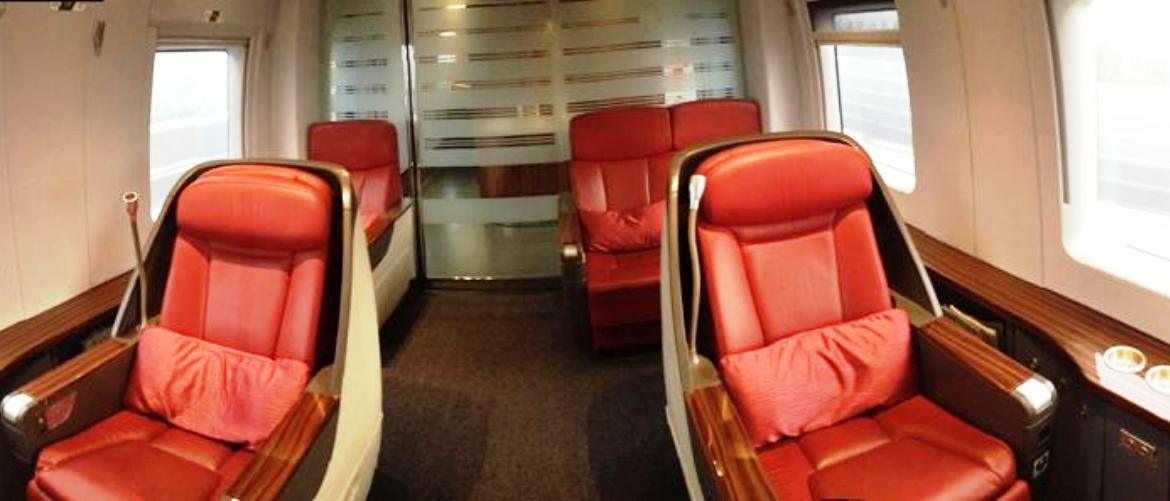
Chinese high speed passenger rail service offers three classes: executive, first and second. Our tour groups are booked in second class. Upon request, upgrade to first class can be made subject to extra cost and unavailability. In first class there are 4 seats per row whereas in second class there are 5 seats per row with 3 seats one side of the aisle and 2 on the opposite side. Compared with second class, first class seats are wider, recline more and have a footrest that second class doesn’t. Executive class is one level higher than first class and the leather seats recline flat.
Related topics:
- 23-day Classic China by High-speed Train
- 21-day Highlights of China by High-speed Train
- 15-day Southeast China by High-speed Train
- 13-day China Experience by Bullet Train
- More train photos on our Facebook page
All of our of China tour itineraries feature high-speed train for inter-city travels and we go by first class most of the time. This 23-day luxury Classic China tour by bullet train below is a perfect example.
Classic China by Train (23 days)
Shanghai – Suzhou – Qufu – Beijing – Xi’an – Chengdu – Chongqing – Yangtze Cruise – Yichang – Wuhan – Guilin – Hong Kong
Embark on this luxury tour of China by train through the heart of China, where ancient traditions harmonize with cutting-edge modernity, and each city tells a tale woven into the fabric of a nation steeped in history. This leisurely placed grand tour of China is a captivating journey that transcends time, offering an immersive experience that showcases the best of China’s cultural heritage, breathtaking landscapes, and dynamic urban centers.
On this fully guided Luxury Tour of China by Train, you’ll travel between the cities exclusively by high-speed train, thus eliminating air travel-related hassles. Travelling by train also allows you to see the countryside and mingle with locals.
Important Features
- Small group size – average 15, maximum 20
- Expert guides handpicked by company owners
- Inter-city travel exclusively by high-speed train
- No annoying forced shopping stops
- Quality meals at non-tourist restaurants
- Unlimited supply of bottled water during group activities
- Outside cabin on or above bridge deck for Yangtze cruise
- Complimentary Wi-Fi on cruise ship and in all hotels
- Visit to chambers in Forbidden City that most tour operators leave out
- Great Wall visit at Mutianyu including cable car rides
- Day hike at Longji terraced rice fields
Options Available
- Half-day Jewish heritage tour in Shanghai
- Peking Opera show with dinner in Beijing
- Tang Dynasty cultural show with dinner in Xi’an
- Traditional face mask changing performance with dinner in Chengdu
Meal Code: B = breakfast / L = lunch / D = dinner
Day 1/Thu: Departing for Shanghai
Depart from a city of your choice and lose a day upon crossing the International Date Line.
Day 2/Fri: Arrival in Shanghai
Meet the driver on arrival for transfer to the hotel. You’ll have the balance of the day at leisure. The guide will get in touch with you tonight.
Day 3/Sat: Shanghai (B/L/D)
With a population of 24.9 million (2021), Shanghai is China’s biggest city, which delights the visitor with its futuristic skyline and historical landmarks.
Following the tour orientation we visit Jade Buddha Temple located in an old neighbourhood, the famous waterfront promenade known as the Bund, and the Yu Garden in the old town centre. We wrap up the day with a drive through the glitzy financial district of Lujiazui on the opposite side of the Bund across Huangpu River.
Day 4/Sun: Shanghai (B)
Free day to explore on your own. We recommend Shanghai Museum and the Urban Planning Exhibition Center nearby. Shanghai Museum is frequently cited by visitors as one of the best of its kind in China, it is also a great place to explore on your own.
Day 5/Mon: Shanghai – Suzhou (B/L)
After a leisurely breakfast we drive 85 km to Suzhou. Ancient Suzhou is most famous for its gardens, canals and silk industry. In the late 13th century a Venetian named Marco Polo visited Suzhou and was very impressed by what he saw. He vividly described the prosperous silk industry and dubbed Suzhou “Venice of the East” due to the small waterways crisscrossing the city…